Physics - Online Test

Q1. A steel cable with a radius of 1.5 cm supports a chairlift at a ski area. If the maximum stress is not to exceed  N  , what is the maximum load the cable can support?
Answer : Option B
Explaination / Solution:
No Explaination.


Q2.

An ideal gas is enclosed in a cylinder with a movable piston on top. The piston has a mass of 8 000 g and an area of 5.00  and is free to slide up and down, keeping the pressure of the gas constant. How much work is done as the temperature of 0.200 mol of the gas is raised from 20.0 C to 300C?


Answer : Option C
Explaination / Solution:

in isobaric process


Q3. Two bodies of masses 10 kg and 20 kg respectively kept on a smooth, horizontal surface are tied to the ends of a light string. a horizontal force F = 600 N is applied to the 10 kg mass so as to pull it. What is the tension in the string?
Answer : Option C
Explaination / Solution:

Let, T= tension on the string

a = acceleration, m1 = mass of light body= 10 kg and m2= mass of heavy body = 20 kg


Now the tension in the string will be,


Q4. Drift is the random motion of the charged particles within a conductor,
Answer : Option A
Explaination / Solution:

The electrons in a conductor have random velocities and when an electric field is applied, they suffer repeated collisions and in the process move with a small average velocity, opposite to the direction of the field. This is equivalent to positive charge flowing in the direction of the field.

Q5. A trolley of mass 200 kg moves with a uniform speed of 36 km/h on a frictionless track. A child of mass 20 kg runs on the trolley from one end to the other (10 m away) with a speed of 4 m  relative to the trolley in a direction opposite to the its motion, and jumps out of the trolley. How much has the trolley moved from the time the child begins to run?
Answer : Option A
Explaination / Solution:

Mass of troly M = 200Kg

mass of child m = 20Kg

speed of trolley v = 36Km/hr=36 x 5/18 = 10m/s

Let v' be the final velocity of the trolley with respect to the ground.

Final velocity of the boy with respect to the ground = 

from conservation of linear momentum


Time taken by the boy to run t = 10/4 = 2.5 sec

Distance moved by the trolley = 

Q6. An alpha particle (charge 2e) is aimed directly at a gold nucleus (charge 79e). What minimum initial kinetic energy must the alpha particle have to approach within 5.0 * 10-14 m of the center of the gold nucleus before reversing direction? Assume that the gold nucleus, which has about 50 times the mass of an alpha particle, remains at rest.
Answer : Option A
Explaination / Solution:
No Explaination.


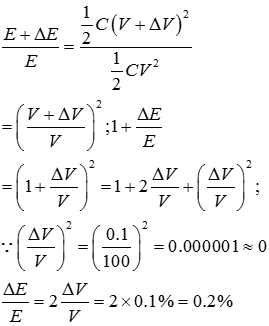
Q7. If the potential difference between the plates of a capacitor is increased by 0.1%, the energy stored in the capacitor increases by very nearly
Answer : Option C
Explaination / Solution:

The initial energy stored in the capacitor at potential difference V is When the p.d is increased by ,the energy stored is Solving,


Q8. The radius of gyration of a solid disc about one of its diameter is given by
Answer : Option D
Explaination / Solution:

Moment of inetia of axis passing through its center and perpendicular to its plane:

 I = ½ MR2

Using perpendicular axis theorem   Ix +Iy = Iz  ,so  2Id = ½ MR2

Moment of inetia of  along its diameter  Id = ¼MR2

And the radius of gyration    MK2  = ¼MR2   



Q9. One thousand small water droplets of equal size combine to form a big drop. The ratio of the final surface energy to the total initial surface energy is
Answer : Option C
Explaination / Solution:
No Explaination.


Q10. In β-decay, the nucleus emits.
Answer : Option A
Explaination / Solution:

In nuclear physics, beta decay (β-decay) is a type of radioactive decay in which a beta ray (fast energetic electron or positron), and a neutrino are emitted from an atomic nucleus. For example, beta decay of a neutron transforms it into a proton by the emission of an electron, or conversely a proton is converted into a neutron by the emission of a positron (positron emission), thus changing the nuclide type.