Physics - Online Test

Q1. The reason why cyclists bank when taking a sharp turn is
Answer : Option A
Explaination / Solution:

In order to take a safe turn, the cyclist has to bend a little from his vertical position. In this case, a component of the reaction provides the required centripetal force.

If q is angle made by the cyclist with the vertical then
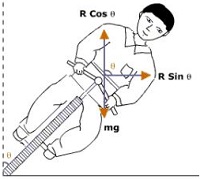


Dividing (2) by (1), we get


=> 

In actual practice, the value of q is slightly less because the force of friction also contributes towards the centripetal force.
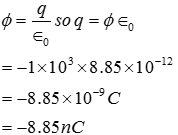

Q2. A point charge causes an electric flux of to pass through a spherical Gaussian surface of 10.0 cm radius centred on the charge. (a) If the radius of the Gaussian surface were doubled, how much flux would pass through the surface? (b) What is the value of the point charge? 
Answer : Option A
Explaination / Solution:

(a) Electric flux is given by since amount of charge not depends on size and shape so by making radius double the amount of charge remain same so electric flux remain same. 


Q3. Four identical hollow cylindrical columns of mild steel support a big structure of mass 50,000 kg. The inner and outer radii of each column are 30 and 60 cm respectively. Assuming the load distribution to be uniform, calculate the compression strain of each column. . Take Young's modulus of steel as 20   Pa
Answer : Option C
Explaination / Solution:
No Explaination.


Q4. A water heater is operated by solar power. If the solar collector has an area of 6.00  and the power delivered by sunlight is 550 W/ , how long does it take to increase the temperature of 1.00  of water from 20.0C to 60.0C?
Answer : Option D
Explaination / Solution:


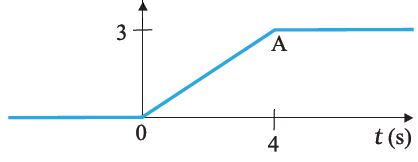
Q5. Figure shows the position-time graph of a particle of mass 4 kg. What is the impulse at t = 0 and t = 4 s ? (Consider one-dimensional motion only)

Answer : Option D
Explaination / Solution:

Initial velocity u=0, between t= 0s and t=4s, the particle has a constant velocity,

therefore slope of OA is  

At t= 0,Impulse=Change in momentum

                        = 

At t= 4s, initial velocity is 3/4 m/s,

So, the Impulse = 
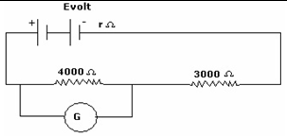

Q6. In the figure, when an ideal voltmeter is connected across 4000 ohm resistance, it reads 30 volts. If the voltmeter is connected across 3000 ohms resistance. It will read

Answer : Option B
Explaination / Solution:

An ideal voltmeter does not draw any current. Therefore the resistances 4000 Ω and 3000 Ω are in series. The current in the circuit


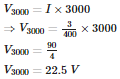
The potential difference across the 3000 Ω resistor


Q7. A bolt of mass 0.3 kg falls from the ceiling of an elevator moving down with an uniform speed of 7 m/s. It hits the floor of the elevator (length of the elevator = 3 m) and does not rebound. What is the heat produced by the impact?
Answer : Option B
Explaination / Solution:

Whole of the potential energy of bolt converted in to heat energy heat produced by the impact = mgh =0.3×9.8×3=8.82J


Q8. It is found experimentally that for small thickness t, the number of α-particles scattered at moderate angles is proportional to t. What clue does this linear dependence on t provide?
Answer : Option D
Explaination / Solution:
No Explaination.


Q9. The plates of a parallel plate capacitor are 10 cm apart and have area equal to 2m2. If the charge on each plate is , the electric field at a point
Answer : Option A
Explaination / Solution:

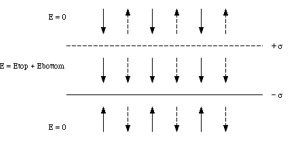
The electric field outside two large plates with opposite charge densities will be zero. 

The electric field between the plates of the capacitor 
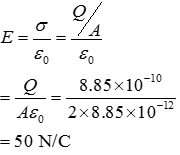
and it is a constant electric field.

Q10. Weak Nuclear Force
Answer : Option A
Explaination / Solution:

The weak nuclear force stops a neutron from decaying into a proton and an electron. When this happens, an electron leaves the atom. This is known as beta decay.