Physics - Online Test

Q1. In a Wheatstone’s bridge, P = 9 ohms, Q = 11 ohms, R = 4 ohms and S = 6 ohms. How much resistance must be put in parallel to the resistance S to balance the wheatstone bridge?
Answer : Option A
Explaination / Solution:

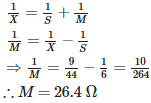
Let a resistance M be put in parallel to S and the equivalent resistance of the parallel combination be X. In the bridge balance condition 


In the parallel combination of S and M,


Q2. Two pendulums have time periods T and 5T/4. They are in phase at their mean positions at some instant of time. What will be their phase difference when the bigger pendulum completes one oscillation?
Answer : Option D
Explaination / Solution:

Assuming bigger pendulum as the pendulum of bigger time period i.e.having time period 

As the two pendulums start at the same time in simple harmonic motion from the mean position,their initial phase angles are zero

The bigger pendulum completes its one oscillation in time  and comes back to the mean position.During this time the point on reference circle associated with SHM rotates by an angle 2π

If ω represents the angular velocity of the reference point associated with SHM of first pendulum of time period T,then the phase of the this pendulum after  s willbe


Hence the phase difference


= 90

Q3. Monochromatic light of wavelength 589 nm is incident from air on a water surface. What is the wavelength and speed of reflected light?
Answer : Option A
Explaination / Solution:
No Explaination.


Q4. A short bar magnet placed with its axis at  with a uniform external magnetic field of 0.25 T experiences a torque of magnitude equal to J. What is the magnitude of magnetic moment of the magnet?
Answer : Option B
Explaination / Solution:
No Explaination.


Q5. Two straight horizontal parallel wires are carrying the same current in the same direction, d is the distance between the wires. You are provided with a small freely suspended magnetic needle. At which of the following positions will the orientation of the needle be independent of the magnitude of the current in the wires
Answer : Option D
Explaination / Solution:

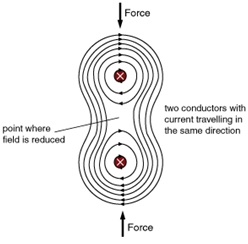
Consider two wires carrying current in the same direction as shown. The current acts inwards to the plane of the screen. The magnetic field lines are in the plane of the screen and are concentric circles. At the point midway between the wires, the field lines are directed opposite to each other. The magnetic fields due to

the two wires are directed opposite to each other. They also have the same magnitude since the wires carry currents of equal magnitude. At a distance d/2, in the horizontal plane, the net magnetic field is zero. A magnetic needle placed at this point experiences no force. The orientation of the needle becomes independent of the current in the wires

Q6. For forward biasing a P-N junction the positive terminal of the battery is connected to
Answer : Option C
Explaination / Solution:

Biasing is the application of a voltage across a p–n junction.
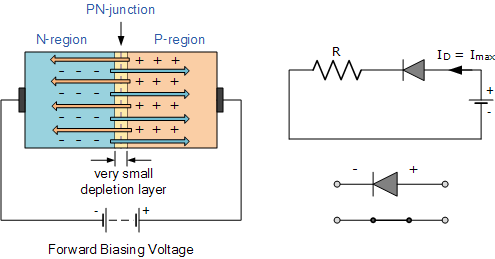
When we connect p-type region of a junction with the positive terminal of a voltage source and n-type region with the negative terminal of the voltage source, then the junction is said to be forward biased.

At this condition, due to the attraction of positive terminal of source, electrons which participated in covalent bond creations in p-type material, will be attracted towards the terminal.


Q7. A jet lands on an aircraft carrier at 30 m/s. What is its acceleration if it stops in 2.0 s?
Answer : Option A
Explaination / Solution:

Initial velocity u = 30 m/s

As it stops then final velocity v = 0 m/s

Time taken t = 2.0 s

We know,

v-u = at

=> 0-30= 2a

=> a = 

-ve sign shows velocity is decreasing.

Q8. A tuning fork of frequency 500 Hz is sounded on a resonance tube. The first & second resonances are obtained at 17 cm and 52 cm. The velocity of sound in m/s is
Answer : Option C
Explaination / Solution:
No Explaination.


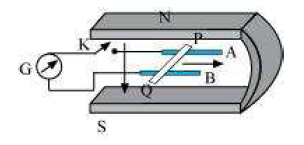
Q9. Figure shows a metal rod PQ resting on the smooth rails AB and positioned between the poles of a permanent magnet. The rails,the rod, and the magnetic field are in three mutual perpendicular directions. A galvanometer G connects the rails through a switch K. Length of the rod = 15 cm, B = 0.50 T, resistance of the closed loop containing the rod = . Assume the field to be uniform. Suppose K is open and the rod is moved with a speed of 12 cm  in the direction shown. Polarity and magnitude of the induced emf are

Answer : Option D
Explaination / Solution:


According to lenz's law P is positive end



Q10. Use the formula  T = 0.29 cmK to obtain the characteristic temperature range for m
Answer : Option B
Explaination / Solution:
No Explaination.