Physics - Online Test
Q1. Electric Potential V at a point in an electrical field is
Answer : Option D
Explaination / Solution:
Electric potential V is the work done in bringing unit positive charge from infinity to the point in an electric field, and the potential energy is the work done in bringing any finite charge from infinity to the point in an electric field. They are related as, .If q =1C,
Q2. Pressure p at any point in a fluid at rest is
Answer : Option D
Explaination / Solution:
It is important to note that it is valid only for a fluid at rest. In the case of a moving fluid, pressures in different directions could be different depending upon fluid accelerations in different directions.
Q3. According to Atomic Hypothesis:
Answer : Option C
Explaination / Solution:
atomic hypothesis that all things are made of atoms—little particles that move around in perpetual motion, attracting each other when they are a little distance apart, but repelling upon being squeezed into one another.
Q4. A free neutron decays into
Answer : Option D
Explaination / Solution:
Free neutrons are unstable. A free neutron () decays into a proton (), an electron (), and an electron antineutrino (). This phenomenon is called beta decay.
Q5. Focal length of a mirror is given by
Answer : Option B
Explaination / Solution:
No Explaination.
Q6. direction of magnetic force on a positive charge moving in a magnetic field is given by
Answer : Option C
Explaination / Solution:
The force experienced by a charged particle in a magnetic field is given by .The right hand rule for vector product can be used to determine the direction of .
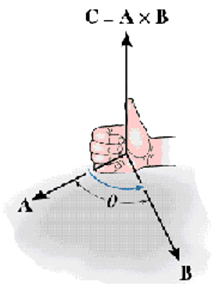
Q7. 180 equal intervals between two reference points on Fahrenheit scale correspond to
Answer : Option B
Explaination / Solution:
ΔTC100=ΔTF180
Q8. Unit for a fundamental physical quantity is
Answer : Option C
Explaination / Solution:
Unit is the reference used as the standard measurement of a physical quantity. The unit in which the fundamental quantities are measured are called fundamental unit and the units used to measure derived quantities are called derived units.
Q9. Potentiometer measures the potential difference more accurately than a voltmeter, because
Answer : Option D
Explaination / Solution:
Potentiometer measures the potential difference using null deflection method, where no current is drawn from the cell; whereas voltmeter needs a small current to show deflection. So, accurate measurement of p.d is done using a potentiometer.
Q10. Period of a periodic motion is the ________ interval of time after which the motion is __________.
Answer : Option B
Explaination / Solution:
Time period of an oscillatory motion is the smallest interval of time for one complete oscillation.As when we apply the force on the bob,bob moves from mean position to extreme position then form extreme position to mean position and then again from mean to extreme in opposite direction and at last come to mean position.The time taken by bob in this whole process is called period of oscillation.