Electronics Engineering - Online Test
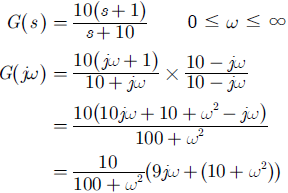
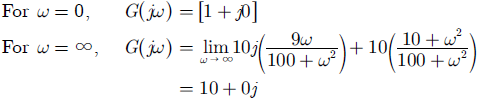
Q1. The polar plot of the transfer function  will be in the
will be in the
Answer : Option A
Explaination / Solution:
Q2. A two-port network has scattering parameters given by  If the
port-2 of the two port is short circuited, the S11 parameter for the resultant one
If the
port-2 of the two port is short circuited, the S11 parameter for the resultant one
If the
port-2 of the two port is short circuited, the S11 parameter for the resultant one
Answer : Option B
Explaination / Solution:
No Explaination.
Q3.
What are the minimum numbers of NOT gates and 2 - input OR gates required to design the logic of the driver for this 7 - Segment display
Answer : Option D
Explaination / Solution:
As shown in previous solution 2 NOT gates and 3-OR gates are required.
Q4. If the unit step response of a network is (1 – e-αt), then its unit impulse response is
Answer : Option A
Explaination / Solution:

Q5. The electric field of a uniform plane wave travelling along the negative z direction is given by
the following equation:
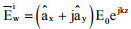
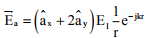
This wave is incident upon a receiving antenna placed at the origin and whose radiated electric
field towards the incident wave is given by the following equation:
The polarization of the incident wave, the polarization of the antenna and losses due to the
polarization mismatch are, respectively,
Answer : Option C
Explaination / Solution:
No Explaination.
Q6. Negative feedback in a closed-loop control system DOES NOT
Answer : Option B
Explaination / Solution:
Negative feedback in closed-loop control system does not reduce bandwidth.
Q7. A 230 V rms source supplies power to two loads connected in parallel. The first load draws 10 kW at 0.8 leading power factor and the second one draws 10 kVA at 0.8 lagging power factor. The complex power delivered by the source is
Answer : Option B
Explaination / Solution:
Consider the circuit diagram for given problem as shown below
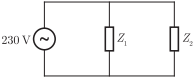
Load delivered to Z1 is
P1 = 10 kW
cos ϕ1
= 0.8, leading
So, we obtain the complex power delivered to Z1 as
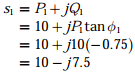
Again, the delivered power to load Z2 as
|s1|= 10 kVA
cos ϕ2 = 0.8, lagging
So, we obtain the complex power delivered to load Z2 as
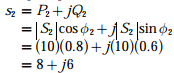
Hence, the total complex power delivered by the source is
s1 + s2 = (10 – j7.5) + (8
+ j6)
= (18 - j1.5) kVA
Q8. A bulb in a staircase has two switches, one switch being at the ground floor and the other one at the first floor. The bulb can be turned ON and also can be turned OFF by any one of the switches irrespective of the state of the other switch. The logic of switching of the bulb resembles
Answer : Option C
Explaination / Solution:
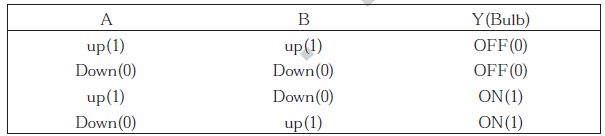

Let A denotes the position of switch at ground floor and B denotes the position of switch at upper floor. The switch can be either in up position or down position.Following are the truth table given for different combinations of A and B
When the switches A and B are both up or both down, output will be zero (i.e.Bulb will be OFF). Any of the switch changes its position leads to the ON state of bulb. Hence, from the truth table, we get
i.e., the XOR gate
Q9. An input  is applied to an LTI system with
impulse response h(t) = u(t). The output is
is applied to an LTI system with
impulse response h(t) = u(t). The output is
is applied to an LTI system with
impulse response h(t) = u(t). The output is
Answer : Option D
Explaination / Solution:
 and h(t) = u(t)
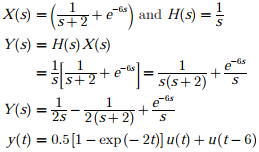
and h(t) = u(t)Taking Laplace Transform we get
Q10. The far-zone power density radiated by a helical antenna is approximated as:

The radiated power density is symmetrical with respect to ϕ and exists only in the upper
hemisphere: C0 is a constant. The power radiated by the antenna (in
watts) and the maximum directivity of the antenna, respectively, are
Answer : Option B
Explaination / Solution:
No Explaination.