Electronics Engineering - Online Test
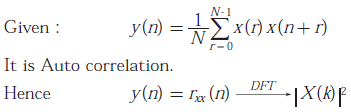
Q1. { x(n)} is a real - valued periodic sequence with a period N . x(n) and X(k) form N-point Discrete Fourier Transform (DFT) pairs. The DFT Y(k) of the sequence 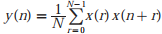 is
is
is
Answer : Option A
Explaination / Solution:
Q2. The maximum value of ᶿ until which the approximation sin ᶿ=ᶿ holds to within 10% error is
Answer : Option B
Explaination / Solution:
Here, as we know
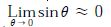
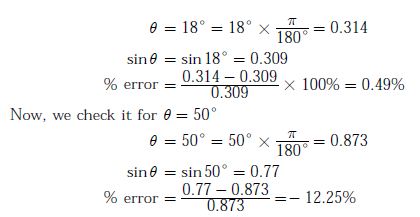
but for 10% error, we can check option (B) first
so, the error is more than 10%. Hence, for error less than 10%, ᶿ = 18º can have the approximation
Q3. A speed signal, band limited to 4 kHz and peak voltage varying between +5 V and -5 V, is sampled at the Nyquist rate. Each sample is quantized and represented by 8 bits.
The number of quantization levels required to reduce the quantization noise by a factor of 4 wo
Answer : Option B
Explaination / Solution:
No Explaination.
Q4. 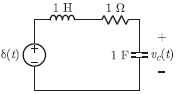
The following series RLC circuit with zero conditions is excited by a unit impulse functions 𝛿(t).
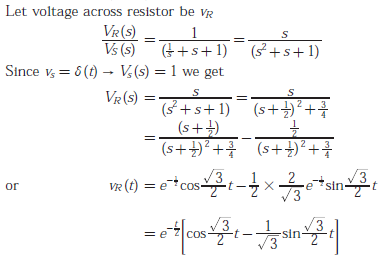
For t > 0, the voltage across the resistor is
Answer : Option B
Explaination / Solution:
Q5. The channel resistance of an N-channel JFET shown in the figure below is 600Ω when the full channel thickness (tch) of 10μm is available for conduction. The built-in voltage of the gate P+ N junction (Vbi) is -1 V. When the gate to source voltage (VGS) is 0 V, the channel is depleted by 1 μm on each side due to the built in voltage and hence the thickness available for conduction is only 8 μm
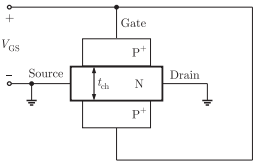
The channel resistance when VGS = 0 V is
Answer : Option C
Explaination / Solution:

Q6. 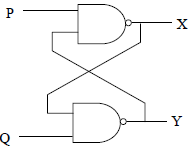
In the latch circuit shown, the NAND gates have non-zero, but unequal propagation delays. The present input condition is: P = Q = '0'. If the input condition is changed simultaneously to P = Q = '1', the outputs X and Y are
Answer : Option B
Explaination / Solution:
Unequal propagation delay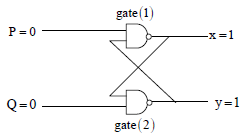
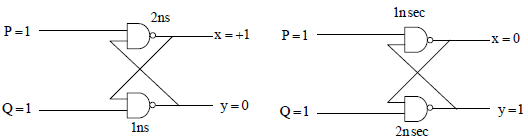
Case I: Case II:
Gate 1⟶2ns Gate 1⟶1nsec
Gate 2⟶1ns Gate 2⟶2nsec
Either x = 1, y = 0 or x = 0, y =1
Q7. 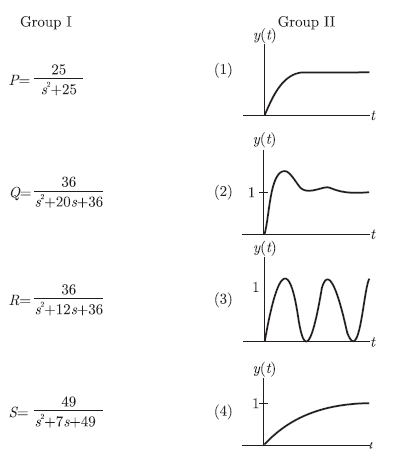
Group I lists a set of four transfer functions. Group II gives a list of possible step response y(t). Match the step responses with the corresponding transfer functions.
Answer : Option D
Explaination / Solution:
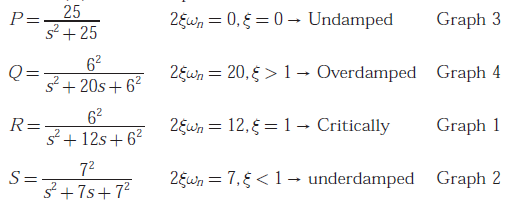
Q8.
The bit rate of a digital communication system is R kbits/s. The modulation used is 32-QAM. The minimum bandwidth required for ISI free transmission is
Answer : Option B
Explaination / Solution:

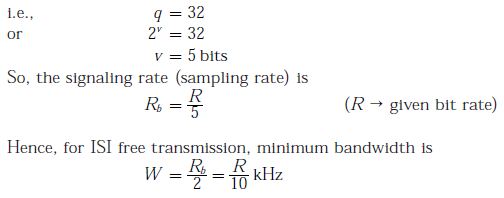
In ideal Nyquist Channel, bandwidth required for ISI (Inter Symbol reference) free transmission is
Here, the used modulation is 32 - QAM (Quantum Amplitude modulation
Q9. 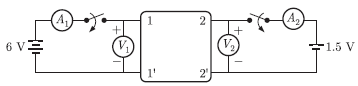

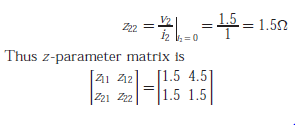
A two-port network shown below is excited by external DC source. The voltage and the current are measured with voltmeters V1,V2 and ammeters. A1,A2 (all assumed to be ideal), as indicated
Under following conditions, the readings obtained are:
The z -parameter matrix for this network is
Answer : Option C
Explaination / Solution:
From the problem statement we have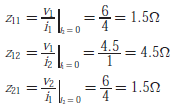
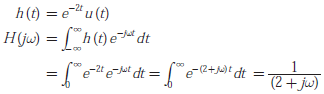
Q10. The impulse response h(t) of linear time - invariant continuous time system is given by h(t) = exp(- 2t)u(t), where u(t) denotes the unit step function.
The frequency response H(𝜔) of this system in terms of angular frequency 𝜔, is given by H(𝜔)
Answer : Option C
Explaination / Solution: