Computer Science Engineering - Online Test
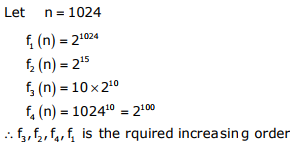
Q1. Which of the given options provides the increasing order of asymptotic
complexityoffunctions f1,f2,f3 and f4?

Answer : Option A
Explaination / Solution:
Q2. Consider the languages L1, L2 and L3 as given below
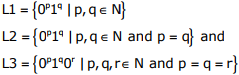
Which of the following statements is NOT TRUE?
Answer : Option C
Explaination / Solution:
L1: regular language
L2: context free language
L3: context sensitive language
Q3. Which of the following is TRUE?
Answer : Option C
Explaination / Solution:
Option A is false since BCNF is stricter than 3NF (it needs LHS of all FDs should be candidate
key for 3NF condition)
Option B is false since the definition given here is of 2NF
Option C is true, since for a relation to be in BCNF it needs to be in 3NF, every relation in
BCNF satisfies all the properties of 3NF.
Option D is false, since if a relation is in BCNF it will always be in 3NF.
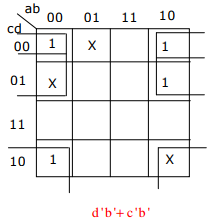
Q4. What is the minimal form of the Karnaugh map shown below? Assume that X denotes a don’t
care term.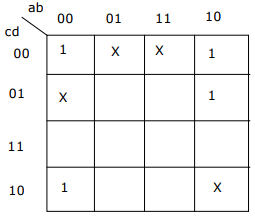
Answer : Option B
Explaination / Solution:
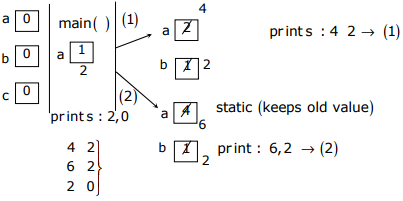
Q5. Consider the following C code segment:
int a, b, c = 0;
void prtFun(void);
main( )
{ static int a = 1; /* Line 1 */
prtFun( );
a + = 1;
prtFun( )
printf(“\n %d %d “, a, b);
}
void prtFun(void)
{ static int a=2; /* Line 2 */
int b=1;
a+=++b;
printf(“\n %d %d “, a, b);
}
What output will be generated by the given code segment?
Answer : Option C
Explaination / Solution:
Q6. In a k-way set associative cache, the cache is divided into v sets, each of which consists of k
lines. The lines of a set are placed in sequence one after another. The lines in set s are
sequenced before the lines in set (s+1). The main memory blocks are numbered 0 onwards.
The main memory block numbered j must be mapped to any one of the cache lines from
Answer : Option A
Explaination / Solution:
Position of main memory block in the cache (set) = (main memory block number) MOD
(number of sets in the cache).
As the lines in the set are placed in sequence, we can have the lines from 0 to (K – 1) in each
set.
Number of sets = v, main memory block number = j
First line of cache = (j mod v)*k; last line of cache = (j mod v)*k + (k – 1)
Q7. In an IPv4 datagram, the M bit is 0, the value of HLEN is 10, the value of total length is 400
and the fragment offset value is 300. The position of the datagram, the sequence numbers of
the first and the last bytes of the payload, respectively are
Answer : Option C
Explaination / Solution:
M= 0 – Means there is no fragment after this, i.e. Last fragment
HLEN=10 - So header length is 4×10=40, as 4 is constant scale factor
Total Length = 400(40 Byte Header + 360 Byte Payload)
Fragment Offset = 300, that means 300×8 Byte = 2400 bytes are before this last fragment
So the position of datagram is last fragment
Sequence number of First Byte of Payload = 2400 (as 0 to 2399 Sequence no are used)
Sequence number of Last Byte of Payload = 2400+360-1=2759
Q8. 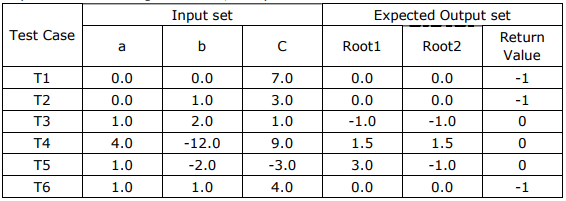
The following is comment written for a C function
/* This function computes the roots of a quadratic equation
a.x^2+b.x+c=0. The function stores two real roots
in *root1 and *root2 and returns the status of validity of
roots. It handles four different kinds of cases.
(i) When coefficient a is zero irrespective of discriminant
(ii) When discriminant is positive
(iii) When discrimanant is zero
(iv) When discrimanant is negative
Only in cases (ii) and (iii), the stored roots are valid.
Otherwise 0 is stored in the roots. the function returns 0 when
the roots are valid and -1 otherwise.
The functin also ensures root1>=root2.
int get_QuadRoots (float a, float b, float c, float *root1, float *root2) ;
*/
A software test engineer is assigned the job of doing black box testing. He comes
up with the following test cases, many of which are redundant.
Which one of the following options provide the set of non-redundant tests using
equivalence class partitioning approach from input perspective for black box
testing?
Answer : Option C
Explaination / Solution:
T1 and T2 checking same condition a = 0 hence, any one of T1 and T2 is
redundant.
T3, T4: in both case discriminant (D)= b2 − 4ac = 0 . Hence any one of it is
redundant.
T5 : D>0
T6 : D<0
Q9. Which one of the following options is CORRECT given three positive integers x, y and z, and a predicate
P (x) = ¬ (x = 1) ∧ ∀y (∃z (x = y * z) ⇒ (y = x) ∨ (y = 1))
Answer : Option A
Explaination / Solution:
No Explaination.
Q10. Consider the following table of arrival time and burst time for three processes P0,
P1 and P2.
Process Arrival time Burst Time
P0 0 ms 9 ms
P1 1 ms 4ms
P2 2 ms 9ms
The pre-emptive shortest job first scheduling algorithm is used. Scheduling is
carried out only at arrival or completion of processes. What is the average
waiting time for the three processes?
Answer : Option A
Explaination / Solution:
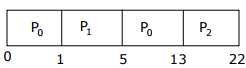
Average waiting time = (4+11)/3 = 5 ms