CBSE 11TH MATHEMATICS - Online Test

Q1. For a symmetrical distribution  and . The median of the data is
Answer : Option D
Explaination / Solution:

For symmetric distribution, 
Q2. The image of the point ( -1 , 2 ) in the origin is
Answer : Option A
Explaination / Solution:

when a point M which is in the 2nd quadrant is reflected in the origin, its image is formed in the 4th quadrant whose coordinates are (x,-y)

Hence the image of the point (1,-2) is (1,-2)


Q3. Logical equivalent proposition to the proposition ∼(p∨q) is
Answer : Option B
Explaination / Solution:

∼(p∨q)≡∼p∧∼q De Morgan's law

Q4. The line y = c is a tangent to the parabola x= y - 1 if c is equal to
Answer : Option C
Explaination / Solution:

putting the value y=c into parabola,we get

x2=c-1

or x2-(c-1)=0

here discriminat=

line y=c is tangent when discriminant is equal to 0.

putting disriminant =0 we get c=1.

(0, c) will be a point on the parabola. 
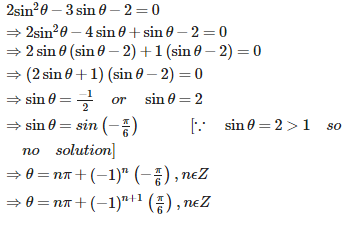

Q5. The general value of θ satisfying the equation  is
Answer : Option B
Explaination / Solution:


Q6.  upto n terms is equal to
Answer : Option B
Explaination / Solution:

Replace n = 1 we have 1/2. When n = 2 we have 1/2+1/6=2/3,( by the principle of mathematical induction when n = 1 we need to take one term from LHS. and for n = 2 we need to take the sum of two terms from the LHS. .....)

Q7. In a certain town , 40% persons have brown hair , 25% have brown eyes , and 15% have both. If a person selected at random has brown hair , the chance that a person selected at random with brown hair is with brown eyes
Answer : Option C
Explaination / Solution:
No Explaination.


Q8. The centre of the sphere , which passes through ( a , 0 , 0 ) , ( 0 , b , 0 ) ( 0 , 0 , c ) and ( 0 , 0 ,0 ) is ? where abc ≠ 0
Answer : Option D
Explaination / Solution:

General equation of the sphere is ---------------------1)

Since 1) passes through the point (0,0,0) using this in 1) we get d=0

Similarly 1) passes through ( a , 0 , 0 ) , ( 0 , b , 0 ) ( 0 , 0 , c ) using these values in 1)


But as abc0  So , a 0 ,b 0 ,c 0

So from above equations , we have a =  - 2g , b= - 2f , c = -2h

 centre is (-f ,-g , -h) = ( a/2 , b/2 , c/2 )


Q9. The number of all possible positive integral solutions of the equation xyz = 30 is
Answer : Option A
Explaination / Solution:

Given xyz=30

We have the possible values of x ,y,z are the following triads 

1,1,30 
1,2,15 
1,3,10 
1,5,6 
2,3,5 
First one can have 3!/2! = 3 ways and the remaining four triads can have 3! combinations 
Hence total combinations = 3 + 4*3! = 27 


Q10.

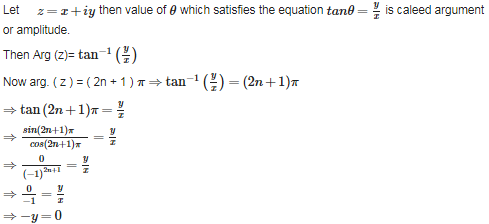
The points of the complex plane given by the condition arg. ( z ) = ( 2n + 1 ) , n  I lie on

Answer : Option A
Explaination / Solution:


Hence the points lie on the negative real semi axis z = x , x 0