CBSE 11TH MATHEMATICS - Online Test

Equation of a line passing through the intersection of two lies is given by ax1 +by1 +c1 + k(ax2 +by2 +c2) = 0
Hence x+2y-3 + k(2x+y-3) = 0
Since it passes through (0,0)
-3 -3k = 0
This implies k = -1
Sustituting for k we get,
x+2y-3 +(-1)(2x+y-3) = 0
-x +y =0 or x - y = 0
Since
 be the equation of circle with (h,k) as the center and r be the radius.
=> k=h+1 or k=1+h --(i)
Circle passes through origin so (0,0) will satisfy the equatio of line so putting (0,0) in equation of circle we get

putting k from (i) into (ii), we get
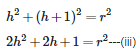
and as the circle touches the line y=x+2 so radius should be equal to the distance from the center to this line.

putting value ok k from (i) in above equation, we get

putting the value of r in (iii)
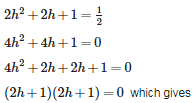
h= putting h in (i) we get k=
hence center is (
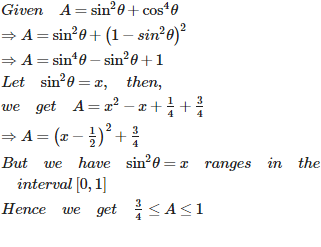
If A = then for all real values of
Total ways of getting 2 and 4 exactly 3 times is 6! / (3! 3!) = 20
Total number of ways in throwing 6 dice is 66
Therefore probability is 20/ 66 = 5/11664
let the point equidistant from the points ( 0 , 0 , 0 ) , ( 1 , 0 , 0 ) , ( 0 , 2 , 0 ) , and ( 0 , 0 , 3 ) is (x ,y ,z)
then according to the given condition and distance formula between two points we have
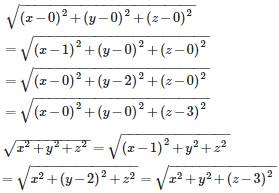
taking ist two expressions and solving them we get

Similarly by taking ist and 3rd we get y = 1 and by taking ist and 4th we get z = 3/2
So the required point is ( 1/2 , 1 , 3/2 )
Since all the plus signs are identical , we have number of ways in which 6 plus signs can be arranged=1.
Now we will have 7 empty slots between these 6 identical + signs
Hence number of possible places of - sign =7
Therefore number of ways in which the 4 minus sign can take any of the possible 7 places=