Zoology - Online Test
Q1. Lymph contains
Answer : Option D
Explaination / Solution:
Lymph contains serum and WBC. Lymph is called as extracellular fluid that help in transport of fat and protein. It contains WBC, so also help in protection against the infection.
Q2. In fungi like ascomycetes and basidiomycetes, an intervening dikaryotic stage occur. Such condition is called
Answer : Option C
Explaination / Solution:
In fungi like ascomycetes and basidiomycetes, an intervening dikaryotic stage (n + n i.e. two nuclei per cell) occurs; such a condition is called a dikaryon and the phase is called dikaryo phase of fungus.
Q3. Species facing competition might evolve mechanism that promotes co-existence rather than exclusion and that mechanism can be
Answer : Option B
Explaination / Solution:
Species facing completion might evolve mechanism that promotes co-existence rather than exclusion that mechanism is called resource partitioning. In which they avoid completion by choosing different times of feeding or different foraging patterns
Q4. Which of the following is not a part of human alimentary canal?
Answer : Option B
Explaination / Solution:
The Ilium is the uppermost and largest bone of the pelvis in vertebrates. Duodenum jejunum and colon are parts of human alimentary canal but ileum is not a part of this system.
Q5. The virus that causes AIDS is
Answer : Option B
Explaination / Solution:
Lymphadenopathy-associated virus (LAV) A former name for HIV is the virus that causes AIDS. It is membrane of lymph nodes. Lymph node get affected and destroy the defense mechanism of human body.
Q6. The correctly matched pair is :
Answer : Option A
Explaination / Solution:
Cats have binocular vision that is cat can use two eyes together. This kinds of vision helps in depth measurement and analysis of the image formed on retian.
Q7. Mitochondria is called “Power house of the cell” because
Answer : Option B
Explaination / Solution:
Mitochondria is called as power house of the cell because it contain enzyme for cellular respiration in which energy is released in form of ATP.
Q8. Amino acid + ATP →Aminoacyl-AMP + P–P , depicts
Answer : Option A
Explaination / Solution:
Amino acid activation refers to the attachment of an amino acid to its Transfer RNA (tRNA).
Aminoacyl transferase binds Adenosine triphosphate (ATP) to amino acid, PP is released. Aminoacyl transferase binds AMP-amino acid to tRNA. Activated amino acids combine with t-RNA.
Q9.
The given graph shows consumption and ventilation during exercise so we can infer from this graph :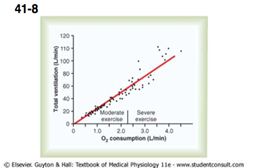
i. During exercise, oxygen consumption rate in our body increases.
ii. Neural stimulus allows abdominal muscles , which are a kind of smooth muscle to contract to facilitate ventilation while exercising.
iii. Increase in ventilation during exercise prevents large changes in the partial pressure of or
iv. The overall impact is breathing rate increases.
Answer : Option A
Explaination / Solution:
During exercise Oxygen consumption and ventilation changes drastically. Oxygen consumption rate in our body increases during exercise. Increase in ventilation during exercise prevents large change in the partial pressure of and to increase breathing rate.
Q10. The thousands of plants obtained through micro-propagation called soma clones because
Answer : Option C
Explaination / Solution:
The method of producing thousands of plants through tissue culture is called micro-propagation. All these plants will be genetically identical to original plant from which they are grown.