Zoology - Online Test
Q1. Which of the following is a gene sanctuary
Answer : Option A
Explaination / Solution:
A gene sanctuary is an area where plants are conserved. It includes both biosphere reserves as well as national parks.
India has set up its first gene sanctuary in the Tura range of Meghalaya for wild relatives of citrus. Efforts are also being made to set up gene sanctuaries for banana, sugarcane, rice and mango.
Q2. A chemical acts slowly, requiring hours to take effect. It may pass in and out of many cells in which they have no effect. When they find appropriate receptor in their target cell they bind to it. Chemical is :
Answer : Option B
Explaination / Solution:
Aldosterone hormone is a chemical that acts slowly, require hours to take effect. It may pass in and out of many cells in which they have no effect. When they find appropriate receptor in their target cell they bind to it to bring about changes.
Q3. Which of these is a fresh water sponge?
Answer : Option C
Explaination / Solution:
Spongilla is a genus of freshwater sponges in the family Spongillidae found in lakes and slow streams. Sponges of the genus Spongilla attach themselves to rocks and logs and filter the water for various small aquatic organisms such as protozoans, bacteria, and other free-floating pond life. Unlike marine sponges, freshwater sponges are exposed to far more adverse and variable environmental conditions, so they have developed gemmules as a means of dormancy.
Q4. In sectional view of female reproductive system, Label (III) and (IV).
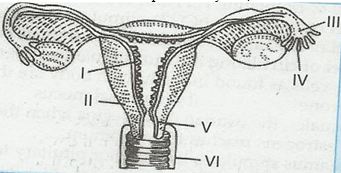
Answer : Option C
Explaination / Solution:
Infundibulum and fimbriae are the parts of fallopian tube (oviduct) through which ovum released from ovary passes towards uterus. Fertilisation of ovum occurs in fallopian tube.
Q5. Which of the following are aromatic amino acids?
Answer : Option D
Explaination / Solution:
Based on number of amino and carboxyl groups, there are acidic (e.g., glutamic acid), basic (lysine) and neutral (valine) amino acids. Similarly, there are aromatic amino acids (tyrosine, phenylalanine, tryptophan).
Q6. Which of the following is correctly matched?
Answer : Option B
Explaination / Solution:
The T-wave represents the return of the ventricles from excited to normal state.
Q7. High value of BOD shows
Answer : Option A
Explaination / Solution:
Biological oxygen demand is the amount of oxygen required to completely decompose the organic waste present in one liter of water by bacteria. High value of BOD shows that water is highly polluted.
Q8. If DDT content in the water of a lake is found to be 0.004 ppm then pelicans of that area will have:
Answer : Option A
Explaination / Solution:
DDT is used as pesticide in crop fields and to kill mosquito in open drains. DDT is not a biodegradable and reaches to nearby water bodies. DDT enters the food chain through aquatic organisms and get magnified at each trophic levels. Pelicans beings at higher trophic levels may contain upto 2 ppm DDT.
Q9. Multinucleate condition arise when Cytokinesis does not follow karyokinesis, this type of cells are called as
Answer : Option D
Explaination / Solution:
Karyokinesis is followed by cytokinesis but some times cytokinesis is not followed by karyokinesis which leads to the establishment of multinucleate condition. This type of cells are called as coenocytes.
Q10. Eco RI acting on goi and vector will produce
Answer : Option C
Explaination / Solution:
Restriction enzymes, such as EcoRI, are used in a wide variety of molecular genetics techniques including cloning, DNA screening and deleting sections of DNA in vitro. Restriction enzymes, like EcoRI, that generate sticky ends of DNA are often used to cut DNA prior to ligation, as the sticky ends make the ligation reaction more efficient.