Zoology - Online Test
Q1. Which is not the universal rule of nomenclature?
Answer : Option D
Explaination / Solution:
According to the universal rule of nomenclature, the biological names are generally in Latin and written in italics. Hence, the correct option is Biological names are generally in Greek.
Q2. Insulin is _____ hormone
Answer : Option C
Explaination / Solution:
Insulin is anabolic hormone because this hormone helps in conversion of glucose into glycogen.
Q3.
From the following figure infer :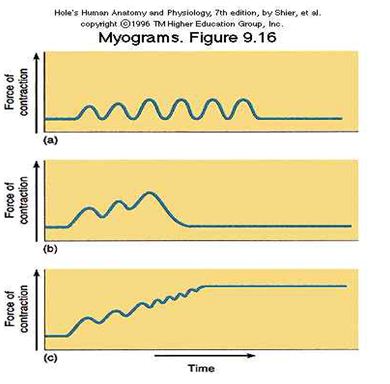
(a) = ?, (b) = ? and (c) = ?
Answer : Option A
Explaination / Solution:
Myograms is diagnostic test of health and functionality of a person’s muscle. In the given myograms,
a. shows staircase effect,
b. shows summation and
c. shows tetanus that leads to fatigue.
Q4. The American company which is involved in the manufacturing of Humulin is
Answer : Option C
Explaination / Solution:
In 1983, Eli Lilly an American company, first prepared two DNA sequences corresponding to A and В chains of human insulin and introduced them in plasmids of Escherichia coli to produce insulin chains. Chains A and В were produced separately, extracted and combined by creating disulfide bonds to form human insulin (humulin).
Q5. It is a disease which affects the mucus membrane of urogenital tract in male and yellow discharge in urine with feeling of illness.
Answer : Option C
Explaination / Solution:
Gonorrhea affects the urogenital tract of male and female both. In male yellow discharge comes out along with urine with itching and irritation.
Q6. The formation of erythrocytes in foetus takes place in
Answer : Option B
Explaination / Solution:
In the early fetus, erythropoiesis takes place in the mesodermal cells of the yolk sac. Later, the production of RBCs starts in the fetal liver and increases till the 2nd trimester. After this, the rate of synthesis begins to decline in liver as erythropoiesis increases in the bone marrow. RBCs are still produced in the liver for approximately 1 week after birth.
Q7. The cell wall of fungi consist of
Answer : Option D
Explaination / Solution:
Cell wall of fungi consists of special sugar molecules called chitin. The cell wall of plants are made up of cellulose.
Q8. In which of the following interaction/s one species is benefitted while other is harmed?
Answer : Option D
Explaination / Solution:
In predation and parasitism one species is benefitted while other is harmed. Parasite obtain food from host by harming them.
Q9. The enzyme which hydrolyze the starch is
Answer : Option B
Explaination / Solution:
The enzymes that break down or hydrolyze starch into the constituent sugars are known as amylases.
Alpha-amylases are found in plants and in animals.
Human saliva is rich in amylase, and the pancreas also secretes the enzyme.
Q10. Which one of the following acts as a physiological barrier to the entry of microorganisms in human body?
Answer : Option C
Explaination / Solution:
Disease causing microorganism enters through different routes into the body. Physiological barrier prevent their entry. Tears acts as physiological barrier for entry of pathogen.