Zoology - Online Test
Q1. The band of nerve fibers that joins the two cerebral hemisphere in mammals is :
Answer : Option D
Explaination / Solution:
The corpus callosum (CC) is the largest of the commissural fibres, linking the cerebral cortex of the left and right cerebral hemisphere.
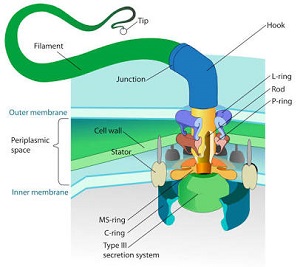
Q2. The bacterial flagellum consists of
Answer : Option D
Explaination / Solution:
A bacterial flagellum has 3 basic parts: a filament, a hook, and a basal body.
1) The filament is the rigid, helical structure that extends from the cell surface.
2) The hook is a flexible coupling between the filament and the basal body.
3) The basal body consists of a rod and a series of rings that anchor the flagellum to the cell wall and the cytoplasmic membrane.
Q3. A phenomenon where the third base of t-RNA at its 5’ end can pair with a non-complementary base of m-RNA is called
Answer : Option D
Explaination / Solution:
In 1966, Francis Crick proposed the Wobble Hypothesis. He postulated that the 5' base on the anticodon, which binds to the 3' base on the mRNA, was not as spatially confined as the other two bases, and could, thus, have non-standard base pairing.
Crick creatively named it for the small amount of play that occurs at this third codon position. Movement ("wobble") of the base in the 5' anticodon position is necessary for small conformational adjustments that affect the overall pairing geometry of anticodons of tRNA.
Q4. Which of the following pyramid/s is/are inverted:
Answer : Option D
Explaination / Solution:
In the aquatic system, the biomass can increase at higher trophic levels. For example, in Oceans, the food chain typically starts with phytoplankton and ends at predatory fish, which has largest biomass. Thus, the pyramid of biomass is inverted in the aquatic systems including marine, ponds etc.
Q5. Those bronchioles which divide into alveolar ducts are called as :
Answer : Option C
Explaination / Solution:
Terminal bronchioles give rise to respiratory bronchioles that ultimately lead to the alveoli. Exchange of gases takes place in alveoli with blood veseels.
Q6. Which of the following helps in absorption of phosphorus from soil by plants?
Answer : Option C
Explaination / Solution:
Anabaena is a photoautotrophic algae that generally grows in rice field. It increase the nitrogen in soil along with it also help in absorption of phosphorous from the soil by the plants.
Q7. Project elephant started in the year:
Answer : Option A
Explaination / Solution:
Project Elephant (PE) was launched by the Government of India in the year 1992 as a Centrally Sponsored Scheme with following objectives:
- To protect elephants, their habitat & corridors
- To address issues of man-animal conflict
- Welfare of captive elephants
Q8. Haemocoel is found in
Answer : Option C
Explaination / Solution:
Haemocoel is the main body cavity of invertebrates such as insects. It is also found in pila which does not contain blood circulating system.
Q9. Failure of testes to descend into scrotum is called
Answer : Option A
Explaination / Solution:
Cryptochidism is an abnormal condition in male reproductive system in which scrotum does not descend outside the abdominal condition. The males may be not able to produce fertile sperm.
Q10. Important site for formation of glycoproteins and glycolipids is
Answer : Option B
Explaination / Solution:
Synthesis of glycoproteins and glycolipids take place in Golgi apparatus inside the cell. Golgi apparatus is located near nucleus of the cell.