Zoology - Online Test
Q1. Adipose tissues in whales and dolphins help in
Answer : Option A
Explaination / Solution:
Adipose tissues in whales and dolphins help in thermoregulation. Adipose tissue stores fats that help maintaining temperature of the body. Fat acts as insulator that maintains constant temperature of the body.
Q2.
Read the following statements :
i. Opening of hepato-pancreatic duct into jejunum is guarded by Sphincter of Oddi.
ii. Duodenum receives bile-pancreatic duct.
Answer : Option A
Explaination / Solution:
Duodenum receives bile from pancreatic duct. Bile contains bile juice that contain bile salt used for emulsification of fat. Sphincter of Oddi is not present between hepatic-pancreatic duct into jejunum.
Q3. The immunoglobulin abundant in colostrum is
Answer : Option C
Explaination / Solution:
Colostrum is the milk secreted by pregnant female after the delivery of baby. This milk contains immunoglobulin IgA that provide immunity to baby from several diseases.
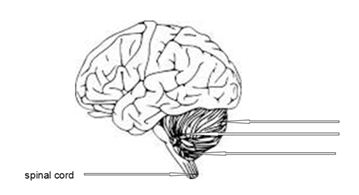
Q4. Label the arrows in the given diagram of brain from top to bottom :
Answer : Option B
Explaination / Solution:
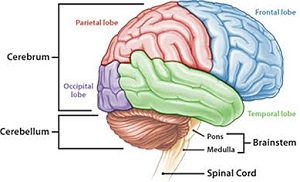
The part of human brain shown above has marked as cerebellum, pons and medulla oblongata of hind brain.
Q5. In certain bacteria, the glycocalyx is forms into loose sheath layer is called as
Answer : Option A
Explaination / Solution:
Glycocalyx differs in composition and thickness among different bacteria. It could be a loose sheath called the slime layer in some, while in others it may be thick and tough called the capsule. The cell wall determines the shape of the cell and provides a strong structural support.
Q6. A single strand of nucleic acid tagged with a radioactive molecule is called
Answer : Option C
Explaination / Solution:
A probe is a fragment of DNA or RNA of variable length (usually 100–1000 bases long) which can be radioactively labeled. It can then be used in DNA or RNA samples to detect the presence of nucleotide sequences (the DNA target) that are complementary to the sequence in the probe.
Q7. The concept of ecological pyramids was developed by :
Answer : Option B
Explaination / Solution:
The concept of ecological pyramid was developed by Charles Elton; these pyramids are also known as Eltonian pyramids. The pyramids are a graphical representation which depicts the number of organisms, biomass and productivity at each trophic level.
Q8.
Match the following:
| Animal | Respiratory Organ |
| a) Nereis | i) Book Lungs |
| b) Limulus | ii) Book Gills |
| c) Palaemon | iii) General Body Surface |
| d) Palamnaeus | iv) Parapodia |
| e) Dugesia | v) Gills |
Answer : Option D
Explaination / Solution:
Respiratory organ of Nereis is parapodia, Limulus is book gills, Palamnaeus is book lungs and respiratory organ of Dugesia is general body surface. Palaemon respire through gills.
Q9. Inbreeding is necessary if you want to evolve a
Answer : Option B
Explaination / Solution:
Pure line is necessary for carrying out breeding programmers. Pure line is obtained by inbreeding plants followed by test crossing until we get homozygous plants for particular traits.
Q10. Which of the following is a biosphere reserve in eastern Himalayan regions:
Answer : Option D
Explaination / Solution:
The Dihang-Dibang Biosphere Reserve is situated in the districts of West Siang, Upper Siang and Dibang valley of Arunachel Pradesh in eastern Himalayan range. This reserve is almost totally forested, having villages and cultivated lands located on lower slopes and terrace edging the major river systems. The reserve is the last stronghold for many Himalayan species.