Zoology - Online Test
Q1. Best method to determine paternity is
Answer : Option B
Explaination / Solution:
DNA paternity testing is the most accurate form of paternity testing possible. If DNA patterns between the child and the alleged father do not match on two or more DNA probes, then the alleged father can be totally ruled out. If the DNA patterns between mother, child, and the alleged father match on every DNA probe, the likelihood of paternity is 99.9 percent.
Q2. The type of placenta found in human beings is
Answer : Option B
Explaination / Solution:
Foetus is attached to uterine wall by placenta. It is a disc-shaped having a number of finger-like chorionic villi. This kind of placenta is called discoidal placenta.
Q3. A baby has been born with a small tail. It is the case exhibiting
Answer : Option D
Explaination / Solution:
Avetism is the tendency to revert to ancestral type. It is a kind of evolutionary throwback, such as traits reappearing which had disappeared generation before. Baby born with small tail is a case of atavism.
Q4. Which of the following procedure is not correctly matched?
Answer : Option B
Explaination / Solution:
ZIFT- Zygote intra fallopian transfer is part of test tube baby programme in which in vitro fertilized zygote in transferred to fallopian tube for implantation and further growth of foetus.
Q5. Process used for amplification or multiplication of DNA for finger printing is
Answer : Option C
Explaination / Solution:
Polymerase chain reaction (PCR) is a wonderful technology for amplifying DNA. It allows you to take a specific region of DNA on the chromosome and through the use of primers, copy back and forth, only a particular desired segment, making two, then four, then eight, then sixteen, and so on, up to millions of copies.
It is possible to start from the DNA segment of a single cell and produce enough of it for use in DNA typing or fingerprinting.
Q6. The process of formation of primary organ rudiment is called
Answer : Option C
Explaination / Solution:
During gestation period organs formation started after three weeks these organs are not completely developed and called primary organ rudiment. The process of formation of primary organ rudiment is called tabulation.
Q7. Which is not a vestigial organ of man?
Answer : Option D
Explaination / Solution:
Vestigial organs are those organs which were functional in our ancestor but become functionless in present form of human beings.
Nail is not a vestigial organ of man as our fingernails are proportionately the same size as our wild counterparts, they are Not reduced structures. They still maintain their original function so they are Not atrophied or functionless.
Q8.
Statement I: In zygote intra fallopian transfer(ZIFT) embryo upto 8 blastomeres are transferred into fallopian tube.
Statement II: In intra uterine transfer, embryo more than 8 blastomeres are transferred to uterus.
Answer : Option A
Explaination / Solution:
In test tube baby programme, sperms and ovum are fertilized in laboratory condition to form zygote. If embryo is transferred up to 8 blastomeres, it is called ZIFT. If embryo having more than 8 blastomeres, it is transferred to uterus called IUT.
Q9. DNA probes used in finger printing are
Answer : Option A
Explaination / Solution:
In finger printing the nylon membrane was incubated with radioactive probes. DNA Probes are small fragments of minisatellite DNA tagged with radioactive phosphorous. The probes only attach to the pieces of DNA that they are complementary to – in this case they attach to the minisatellites in the genome. Radioactive isotopes can be easily identified using scanner.
Q10.
Identify the part of Blastocyst labelled as “A”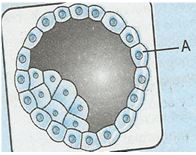
Answer : Option D
Explaination / Solution:
Merula divides mitotically and transforms into blastocyct. The blastomeres in the blastocyst are arranged into an outer layer called trophoblast.