Zoology - Online Test

Q1. PCR and Restriction Fragment Length Polymorphism are the methods for
Answer : Option C
Explaination / Solution:

The main types of Genetic (DNA) fingerprinting methods in use at this time are:

  • Restriction fragment length polymorphism (RFLP) analyzes the length of the strands of the DNA molecules with repeating base pair patterns. The drawback with this system is that it requires a considerable amount of DNA in order to be used.
  • The polymerase chain reaction (PCR) was developed by Karry Mullis of the Cetus Corporation in 1983 for use in research laboratories for establishing hereditary authentication. The drawback was that it was not as discriminating as the RFLP.
  • Amplified fragment length polymorphism (AmpFLP) came into vogue in the 90's and is still popular in the smaller countries involved in the process of DNA fingerprinting.
  • The short tandem repeat (STR) methodology for extracting DNA is the system most widely used form of DNA fingerprinting.
Q2. The embryo at 16-celled stage is called
Answer : Option C
Explaination / Solution:

Zygote undergoes several mitotic divisions to form blastula, which is a spherical hollow structure. Further division in the cells leads to formation of 16-celled stage called as Morula.

Q3. Which of the following is the example of adaptive radiation?
Answer : Option D
Explaination / Solution:

Darwin finches and Australian marsupials are example of adaptive radiations as all the birds evolve from same birds having different beaks and Australian marsupials arise from common ancestors.

Q4. Which one of the following technique is used in test-tube baby programme
Answer : Option C
Explaination / Solution:

Fertilisation outside the followed by embryo transfer is called test-tube. The zygote or early embryo up to 8 blastomere could transferred into fallopian tube is called zygote intra fallopian transfer (ZIFT).

Q5. Satellite DNA is useful tool in
Answer : Option B
Explaination / Solution:

Satellite DNA consists of very large arrays of tandemly repeating, non-coding DNA. Satellite DNA is the main component of functional centromeres, and form the main structural constituent of heterochromatin. It is a useful tool in forensic science as the density of DNA differs in from each other. It is used to identify the individuals form the other.

Q6. The assumption of shape, size and other morphological features by the embryo is called
Answer : Option A
Explaination / Solution:

Morphogenesis is the assumption of shape and size and other morphological features by embryo. It is followed by differentiation to form different types of cells to perform different function.

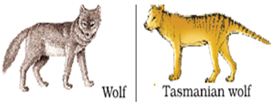
Q7. Picture shown below is example of:-

Answer : Option B
Explaination / Solution:

Wolf and Tasmania Wolf are examples of convergent evolution of placental mammals and Australian marsupials. They are evolved differently due to different in climatic and geographic regions.

Q8. Cryptorchidism is a condition in which
Answer : Option C
Explaination / Solution:

Cryptorchidism is a condition in which testis do not descend into scrotal sac. Formation of sperms inside the testis require 2-3 degree less temperature than body temperature.

Q9. State the use of molecular medicine?
Answer : Option C
Explaination / Solution:

The application of the power of molecular genetics to the problems of human disease plays an important role in many of the research programs in the Department of Biology.

Several complementary approaches are used by our research groups. The power of genomic analysis is used to identify, isolate and characterize genes which cause and contribute to the etiology of human diseases.

Human disease is also studied through the functional analysis of key genes: low density lipoprotein receptors in atherosclerosis and stroke; a broad spectrum of tumor suppressors and oncogenes in cancer, genes directly leading to the disease etiology in neuromuscular disorders such as Alzheimer's, Huntington's disease, and muscular dystrophies.


Q10. Which of the following arise from endoderm?
Answer : Option B
Explaination / Solution:

Human body is triploblastic, having three layered embryo. The outer layer is called ectoderm, the middle layer is called mesoderm and inner most layer is called endoderm that forms lungs and other vital organs.