Zoology - Online Test
Q1. Adrenal medulla consists of a cluster of _____ nerves and those cells are also known as _____ cells :
Answer : Option C
Explaination / Solution:
Adrenal medulla consists of a cluster of sympathetic nerves and those cells are also known as chromaffin cells. Adrenal medulla is part of the adrenal gland located at the center of the adrenal gland.
Q2. Which of the following statements is/are incorrect:
Answer : Option B
Explaination / Solution:
Inside the human intestine a number of microbes lives that helps in digestion of food and formation of vitaminK. so, human intestine is also an unique habitat.
Q3.
Match the cells and their secretions:
| Cell Type | Secretion |
| a) Goblet cell | i) succusentericus |
| b) Oxyntic cells | ii) mucus |
| c) Chief cells | iii) acid |
| d) Intestinal gland cells | iv) pepsinogen |
Answer : Option B
Explaination / Solution:
The intestinal mucosal epithelium has goblet cells which secrete mucus. The secretions of the brush border cells of the mucosa along with the secretions of the goblet cells constitute the intestinal juice or succusentericus. The peptic or chief cells which secrete the proenzyme pepsinogen. The parietal or oxyntic cells secrete HCl acid.
Q4. Hemozoin is released into blood during the infection of Plasmodium vivax every
Answer : Option C
Explaination / Solution:
Plasmodium vivax protozoa cause malaria in human beings having high fever and chill effect at the regular interval of time. Hemozoin is released in blood stream by plasmodium that cause high fever at the interval of 48 hours.
Q5. Brain stem is the support system of brain and is the collective name for :
Answer : Option B
Explaination / Solution:
The brainstem (or brain stem) is the posterior part of the brain, adjoining and structurally continuous with the spinal cord. In the human brain the brainstem includes the midbrain, the pons, and the medulla oblongata. Sometimes the diencephalon, the caudal part of the forebrain, is included.
Q6. Which is common in plant and animal cells
Answer : Option B
Explaination / Solution:
Mitochondria are present in both plant as well as animal cells. Plastids and central vacuoles are present in plant cells and centrioles are present in only animal cells.
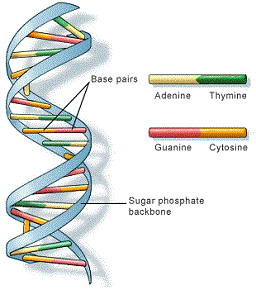
Q7. DNA is made of two chains that twist about one another in the shape of a
Answer : Option C
Explaination / Solution:
Double helix is the description of the structure of a DNA molecule. A DNA molecule consists of two strands that wind around each other like a twisted ladder. Each strand has a backbone made of alternating groups of sugar (deoxyribose) and phosphate groups.
Q8. Term ecosystem was introduced by :
Answer : Option A
Explaination / Solution:
The term "ecosystem" was first used in 1935 in a publication by British ecologist Arthur Tansley.
Tansley devised the concept to draw attention to the importance of transfers of materials between organisms and their environment.
Ecosystem is the functional unit of nature where living and non-living components interact with each other.
Q9. The value of TV is about 500 ml for an average adult human male but only some part of it enters lung alveoli and rest of it fills respiratory passage. What should be the distribution ratio for alveolar volume /respiratory passage volume:
Answer : Option C
Explaination / Solution:
Tidal volume (TV) = volume moved in one breath. Normal = 500 ml
- About 70% of TV reaches alveoli (350 ml) Only this amount is involved in gas exchange
- 30% in airways =respiratory passage (anatomical dead space)
So ratio = 350:150= 7:3
Q10. Picking up plants with superior phenotype for further propagation is
Answer : Option A
Explaination / Solution:
Mass selection is a simplest , common and oldest method of crop improvement, in which large number of plants of similar superior phenotype are selected and their seeds are harvested and mixed together to constitute the new variety.