Zoology - Online Test
Q1. First human population explosion took place due to
Answer : Option D
Explaination / Solution:
First human population explosion occurred due to agriculture system in which people start living together in colonies. They felt the need for more labour powere to perform different agricultural practices.
Q2. Muscle forming cells are called
Answer : Option C
Explaination / Solution:
The muscle forming cells are called myoblasts cells. Myoblast is a type of embryonic progenitor cell that differentiates to give rise to muscle cells.
Q3. Plants complete their life cycle in two phase, saprophytic and gametophytic which occurs alternately called
Answer : Option D
Explaination / Solution:
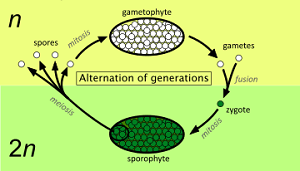
The multicellular haploid plant structure is called the gametophyte, which is formed from the spore and give rise to the haploid gametes. The fluctuation between these diploid and haploid stages that occurs in plants is called the alternation of generations.
Q4. How will you represent a stable population?
Answer : Option C
Explaination / Solution:
Stable populations are theoretical models widely used by demographers to represent and understand the structure, growth and evolution of human populations. By definition, stable populations have age-specific fertility and mortality rates that remain constant over time.
Age pyramids generally shows age distribution of male and female in combined diagram. The stble population shows a bell shaped polygon.
Q5. All are digestive glands except :
Answer : Option A
Explaination / Solution:
Liver, pancrease and salivary gland are digestive gland that release enzymes for digestion of food but thyroid gland release thyroxin hormone that help in metabolism of carbohydrates, proteins and fats.
Q6. Which one of the following is a bridge linking childhood and adulthood?
Answer : Option A
Explaination / Solution:
Adolescence is a bridge linking childhood and adulthood. It is accompanied by several biological and behavioral changes. Thus, it is a very vulnerable phase of mental and psychological development.
Q7. The choroid layer in human eye :
i. darkens the cavity of eyeball to prevent internal reflection of light.
ii. its blood vessels nourish the retina.
iii. it regulates shape of eye lens.
i. darkens the cavity of eyeball to prevent internal reflection of light.
ii. its blood vessels nourish the retina.
iii. it regulates shape of eye lens.
Answer : Option A
Explaination / Solution:
The choroid layer in human eye darkens the cavity of eyeball to prevent internal reflection of light. The blood vessels of choroid layer nourish the retina. The shape of eye lens is changed by ciliary muscles.
Q8. The process of movement of few ions or molecules across the membrane against concentration gradient from higher to lower concentration, it is called
Answer : Option A
Explaination / Solution:
The solutes may move across the membrane by the process of simple diffusion along the concentration gradient, i.e., from higher concentration to the lower.
Q9. Why are UGA, UAG and UAA called termination codons?
Answer : Option D
Explaination / Solution:
The three codons, UAA known as ochre, UAG as amber and UGA as opal, that do not code for an amino acid but act as signals for the termination of protein synthesis. So they also Known bas termination codon.
They are not represented by any tRNA and termination is catalysed by protein release factors.
Q10.
Name the unlabelled parts of given flow chart :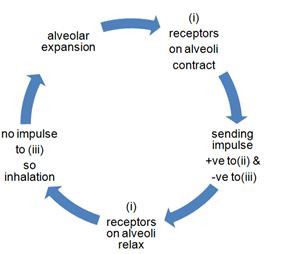
Answer : Option B
Explaination / Solution:
The flow chart of respiratory mechanism labeled as stretch, expiratory centre and inspiratory centre respiratory. It is controlled by the medulla and pons of hind brain.