Zoology - Online Test
Q1. Which of the following can be categorised as a photoautotroph ?
Answer : Option D
Explaination / Solution:
Photoautotrophs are organism that perform photosynthesis in presence of sunlight. Euglena contains chlorophyll and fixes the solar energy so, it acts as photoautotrophs.
Q2. Pharynx is the common passage for food and air but still food do not enter into the windpipe due to the presence of
Answer : Option A
Explaination / Solution:
The epiglottis is a leaf-shaped flap of cartilage located behind the tongue, at the top of the larynx, or voice box. The main function of the epiglottis is to seal off the windpipe during eating, so that food is not accidentally inhaled.
Q3. Taichung Native-1”, a rice variety was introduced in India from
Answer : Option D
Explaination / Solution:
Taichung Native-1 is a rice variety introduced in India from Taiwan. This variety of rice is medium sized having long inflorescence. The maturity period is also shorter than usual varieties of rice.
Q4. When we compare the relationship between species richness and area for wide variety of taxa, the graph appears to be a :
Answer : Option A
Explaination / Solution:
Explanation:
- Alexander Von Humboldt has observed that within a region, species richness gets increased when explored area is increased, but only up to a limit.
- The relationship between species richness and area for a number of taxa like angiospermic plants, fresh water fishes and birds is found to be a rectangular hyperbola.
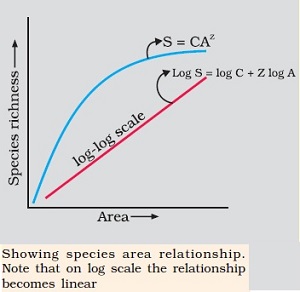
The equation is described by –
log S = log C + Z log A
S – Species Richness
Z – Slope of the line (regression coefficient)
A – Area
C – y-intercept
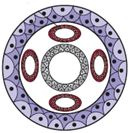
Q5. The cross-section of the body of an invertebrate is given below. Identify the animal which has this body plan.
Answer : Option D
Explaination / Solution:
In some animals, the body cavity is not lined by mesoderm, instead, the mesoderm is present as scattered pouches in between the ectoderm and endoderm. Such a body cavity is called pseudocoelom and the animals possessing them are called pseudocoelomates, e.g.,aschelminthes such as round worm.
Q6. Head of epididymis is called as
Answer : Option D
Explaination / Solution:
Epididymis is a long narrow coiled tube attached to the surface of the testis in mammals and reptiles. It acts as temporary storage organ of spermatozoa received from seminiferous tubules. The head of it is called caput epididymis.
Q7. Select the group of fat soluble vitamins from the followings
Answer : Option C
Explaination / Solution:
Vitamins A, D, E and K are fat soluble but insoluble in water. Vitamin B and C are water soluble vitamins.
Q8. Rh incompatibility develops when :
Answer : Option C
Explaination / Solution:
A special case of Rh incompatibility (mismatching) has been observed between the Rh-ve blood of a pregnant mother with Rh+ve blood of the foetus.
Q9. Which of the following bacterium produces butyric acid?
Answer : Option A
Explaination / Solution:
Clostridium butylicum is used to produce butyric acid. Butyric acid is important industrial chemicals used to process food items.
Q10. In normal adults, the enzyme which catalyses conversion of MHb into Hb is :
Answer : Option C
Explaination / Solution:
Methemoglobin cannot bind oxygen, unlike oxyhemoglobin. It is bluish chocolate-brown in color.
In human blood a trace amount of methemoglobin is normally produced spontaneously, but when present in excess the blood becomes abnormally dark bluish brown.
The NADH-dependent enzyme methemoglobin reductase (MHbreductase enzyme) is responsible for converting methemoglobin back to hemoglobin. . MHb is inactive forms that is converted into Hb that carries oxygen in blood.