Mechanical Engineering - Online Test
Q1. A refrigerator operates between 120 kPa and 800 kPa in an ideal vapor compression cycle with R134a
as the refrigerant. The refrigerant enters the compressor as saturated vapor and leaves the condenser as saturated liquid. The mass flow rate of the refrigerant is 0.2 kg/s. Properties for R-134a
are as follows: 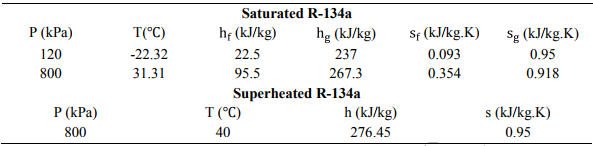
The rate at which heat is extracted, in kJ/s from the refrigerated space is
Answer : Option A
Explaination / Solution:
No Explaination.
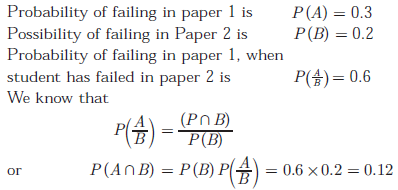
Q2. An examination consists of two papers, Paper 1 and Paper 2. The probability of failing in Paper 1 is 0.3 and that in Paper 2 is 0.2. Given that a student has failed in Paper 2, the probability of failing in Paper 1 is 0.6. The probability of a student failing in both the papers is
Answer : Option C
Explaination / Solution:
Q3. Electrochemical machining is performed to remove material from an iron surface of 20mm ×
20mm under the following conditions:
Inter electrode gap= 0.2mm
Supply voltage (DC)= 12V
Specific resistance of electrolyte = 2Ωcm
Atomic weight of Iron= 55.85
Valency of Iron = 2
Faraday’s constant = 96540 Coulombs
The material removal rate (in g/s) is
Answer : Option A
Explaination / Solution:
No Explaination.
Q4. In an interchangeable assembly, shafts of size  mm mate with holes of size
  mm. The maximum interference (in macrons) in the assembly is
mm mate with holes of size mm. The maximum interference (in macrons) in the assembly is
Answer : Option C
Explaination / Solution:
+ 0.040
– 0.010
Shaft size 25.000 mm
24 mm 90 µm < d5 < 25 mm 40 µm
+ 0.030
+ 0.020
Hole size 
25 mm 20 µm < dh < 25 mm 30 µm
Max Interference
= Max shaft size – Min Hole size
= 25 mm 40 µm – 25 mm 20 µm
= 20 µm
Q5. A refrigerator operates between 120 kPa and 800 kPa in an ideal vapor compression cycle with R134a as the refrigerant. The refrigerant enters the compressor as saturated vapor and leaves the condenser as saturated liquid. The mass flow rate of the refrigerant is 0.2 kg/s. Properties for R-134a are as follows:
The power required for the compressor in kW is
Answer : Option C
Explaination / Solution:
No Explaination.
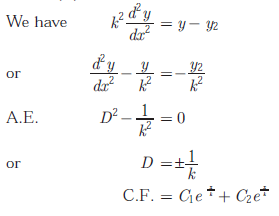
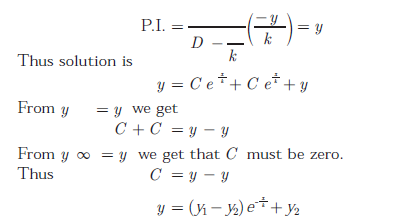
Q6. The solution of the differential equation  under the boundary
conditions
under the boundary
conditions
under the boundary
conditions(i) y = y1 at x = 0 and
(ii) y = y2 at x = ∞, where k, y1 and y2 are constants, is
Answer : Option D
Explaination / Solution:
Q7. Match the following:
NC Code Definition
P. M05 1. Absolute coordinate system
Q. G01 2. Dwell
R. G04 3. Spindle stop
S. G90 4. Linear interpolation
Answer : Option C
Explaination / Solution:
No Explaination.
Q8. For a long slender column of uniform cross section the ratio of critical buckling load for the case
with both ends clamped to the case with both ends hinged is
Answer : Option C
Explaination / Solution:
Critical buckling load for both end clamped = 
Critical buckling load for both end hinged = 
Ratio = 4
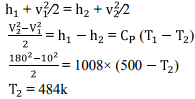
Q9. Air enters an adiabatic nozzle at 300 kPa, 500 K with a velocity of 10 m/s. It leaves the nozzle at
100 kPa with a velocity of 180 m/s. The inlet area is 80 cm2. The specific heat of air Cp is 1008
J/kg.K.
The exit temperature of the air is
Answer : Option C
Explaination / Solution:
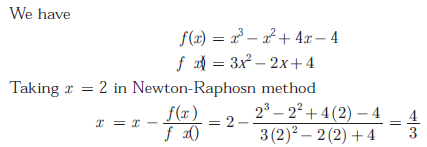
Q10. The equation x − x + x − = is to be solved using the Newton - Raphson method. If x = is taken as the initial approximation of the solution, then next approximation using this method will be
Answer : Option B
Explaination / Solution: