Mechanical Engineering - Online Test
Q1. In the assembly shown below, the part dimensions are:
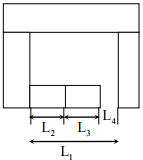
L1 = 22.0±0.01mm,
L2 = L3 = 10.0±0.005mm.
Assuming the normal distribution of part dimensions, the dimension L4 in mm for assembly
condition would be:
Answer : Option D
Explaination / Solution:
Since all dimensions have bilateral tolerances
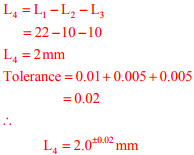
Tolerance is calculated assuming L4 to be sink and tolerance of sink will be cumulative sum
of all tolerances
Q2. Which one of the following configurations has the highest fin effectiveness?
Answer : Option A
Explaination / Solution:
For a given configuration, Thin, closely spaced fins can achieve maximum heat transfer area.
Hence, more effective.
Q3. If E denotes expectation, the variance of a random variable X is given by
Answer : Option A
Explaination / Solution:
The variance of a random variable x is given by
E X − E X
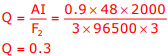
Q4. During the electrochemical machining (ECM) of iron (atomic weight=56,
valency=2) at current of 1000 A with 90% current efficiency, the material
removal rate was observed to be 0.26 gm/s. If Titanium (atomic weight = 48,
valency=3) is machined by the ECM process at the current of 2000 A with 90%
current efficiency, the expected material removal rate in gm/s will be
Answer : Option C
Explaination / Solution:
Q5. In orthogonal turning of a bar of 100 mm diameter with a feed of 0.25 mm/rev,
depth of cut of 4 mm and cutting velocity of 90 m/min, it is observed that the
main (tangential) cutting force is perpendicular to the friction force acting at the
chip-tool interface. The main (tangential) cutting force is 1500 N.
The normal force acting at the chip-tool interface in N is
Answer : Option B
Explaination / Solution:
No Explaination.
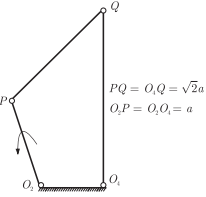
Q6. The input link O2P of a four bar linkage is rotated at 2 rad/s in counter clockwise
direction as shown below. The angular velocity of the coupler PQ in rad/s, at an
instant when O4O2P = 180o, is
Answer : Option C
Explaination / Solution:
No Explaination.
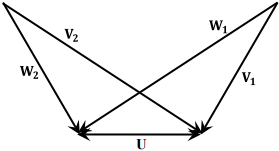
Q7. The velocity triangles at the inlet and exit of the rotor of a turbo-machine are shown. V denotes
the absolute velocity of the fluid, W denotes the relative velocity of the fluid and U denotes the
blade velocity. Subscripts 1 and 2 refer to inlet and outlet respectively. If V2 = W1 and V1 = W2,
then the degree of reaction is
Answer : Option C
Explaination / Solution:
No Explaination.
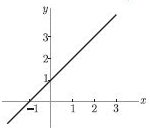
Q8. The following plot shows a function which varies linearly with x . The value of
the integral  is
is
is
Answer : Option B
Explaination / Solution:
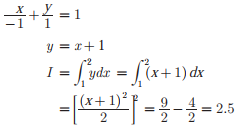
The given plot is straight line whose equation is
Q9. The effective number of lattice points in the unit cell of simple cubic, body centered cubic, and face
centered cubic space lattices, respectively, are
Answer : Option B
Explaination / Solution:
No Explaination.
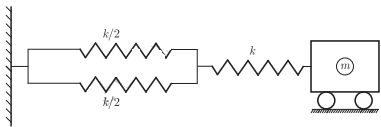
Q10. The natural frequency of the system shown below is
Answer : Option A
Explaination / Solution: