Economics - Online Test
Q1. One of the other two components of Capital budget are
Answer : Option C
Explaination / Solution:
No Explaination.
Q2. Which of the following is NOT a common measure of central tendency?
Answer : Option D
Explaination / Solution:
The Range is the difference between the lowest and highest values of the data.
Q3. The service sector includes activities such as:
Answer : Option C
Explaination / Solution:
The service sector provides a service, not an actual product that could be held in your hand. Activities in the service sector include banks, hotels, real estate education social work, services, recreation, media, communication, electricity, gas and water supply.
Q4. Final goods are those
Answer : Option B
Explaination / Solution:
No Explaination.
Q5. The want satisfying power of a commodity is known as:
Answer : Option D
Explaination / Solution:
No Explaination.
Q6. New plan of action by government to influence production and capital formation activities in the country
Answer : Option A
Explaination / Solution:
NEP, also known as the New Economic Policy was the new plan of action, initiated in 1991 by the then Union Finance minister, Dr. Manmohan Singh. It consisted of wide ranging economic reforms which changed the direction of our developmental strategies.
Q7. If c = 0.8 and m = 0.3, the closed economy multiplier will be
Answer : Option A
Explaination / Solution:
No Explaination.
Q8. Formula given below is used to calculate
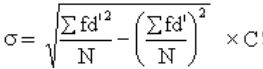
Answer : Option D
Explaination / Solution:
Its a step deviation method to calculate standard deviation.
Q9. The Delhi State Electricity Board (DSEB) was set up in
Answer : Option B
Explaination / Solution:
In the year 1951 the Delhi State Electricity Board (DSEB) came into existence and the responsibility of generation and distribution of electricity.
Q10. Increase of decrease in the Bank balance is ---------
Answer : Option A
Explaination / Solution:
Cash from operating activities usually refers to the net cash inflow reported in the first section of the statement of cash flows. Cash from operating activities focuses on the cash inflows and outflows from a company's main business activities of buying and selling merchandise, providing services, etc.