Economics - Online Test
Q1. In C= -c+b(Y), ‘ -c’ denotes
Answer : Option D
Explaination / Solution:
No Explaination.
Q2. Cotton textile mills were dominated by
Answer : Option D
Explaination / Solution:
Out of 394 cotton mills in undivided India, 380 remained in India and 14 went to Pakistan.
Q3. Identify the bar graph
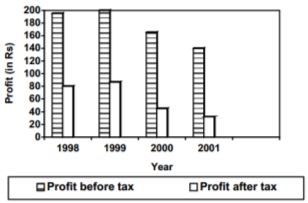
Answer : Option D
Explaination / Solution:
Multiple bar diagrams (m are used for comparing two or more sets of data, in the given bar graph, comparison is shown between profit before tax and profits after tax.
Q4. MSP are determined with the recommendation of the commission for
Answer : Option A
Explaination / Solution:
The government decided the support prices for various agricultural commodities after taking recommendations of Commission for Agricultural Costs and Prices
Q5. Which of the following is not the parameter of human development
Answer : Option C
Explaination / Solution:
Development Index (HDI) combines three dimensions: A long and healthy life: Life expectancy at birth, Education index: Mean years of schooling and Expected years of schooling, A decent standard of living: GNI per capita.
Q6. Large increase in the production of foods grains is due to
Answer : Option B
Explaination / Solution:
The Green Revolution refers to a set of research and development of technology transfer initiatives occurring between the 1930s and the late 1960s. It involves the development of high-yielding varieties of cereal grains, expansion of irrigation infrastructure, modernization of technology etc. which increased the production of foods.
Q7. Financing the deficit is
Answer : Option A
Explaination / Solution:
No Explaination.
Q8. If the values of mean and median are 40 and 48. Find out the most probable value of mode.
Answer : Option D
Explaination / Solution:
When the frequencies are not properly distributed it is called as an asymmetrical or skewed distribution. If it is moderately asymmetrical distribution the following empirical relationship holds good given by Karl Pearson and is expressed as: Mode = 3 Median - 2 Mean. 144 - 80 = 64
Q9. Total employment in India in1950 was
Answer : Option C
Explaination / Solution:
Indian economic policy after independence was influenced by the colonial experience, which was seen as exploitative by Indian leaders exposed to British social democracy and the planned economy of Soviet Union. Domestic policy tended towards protectionism, with a strong emphasis on import substitution industrialisation, economic interventionism, a large government-run public sector, business organisatiob, and central planning. While trade and foreign investment policies were relatively liberal. Five year plans of India resembled central planning in the Soviet Union. Steel, mining, machine tools, telecommunications, insurance, and power plants, among other industries, were effectively nationalised in the mid-1950s.
Q10. Which of the following are not included while estimating domestic product of India?
Answer : Option C
Explaination / Solution:
No Explaination.