Economics - Online Test
Q1. Accommodating Items are also called
Answer : Option B
Explaination / Solution:
No Explaination.
Q2.
Match the following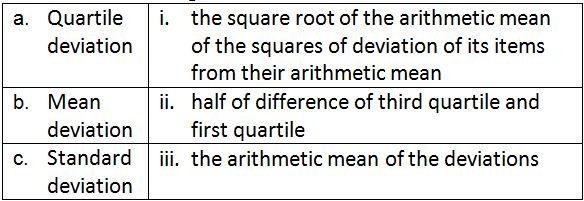
Answer : Option D
Explaination / Solution:
Quartile Deviation (QD) means the semi variation between the upper quartiles (Q3) and lower quartiles (Q1) in a distribution. The mean deviation (also called the mean absolute deviation) is the mean of the absolute deviations of a set of data about the data's mean. Standard deviation is a measure of the dispersion of a set of data from its mean. It is calculated as the square root of variance by determining the variation between each data point relative to the mean. If the data points are further from the mean, there is higher deviation within the data set.
Q3. Which programme the ministry of power has launched to improve the efficiency of thermal stations
Answer : Option B
Explaination / Solution:
Today, the private sector by itself and also in joint partnership with the public sector, has started playing a very important role to improve the efficiency of thermal stations
Q4. All unattainable combinations will lie
Answer : Option D
Explaination / Solution:
Points outside the PPF are unattainable production points given current resources and technologies. It is impossible for an economy to produce outside its PPF. The PPF can change, however, with changes in resources or technology.
Q5. What happens to AR when MR is zero
Answer : Option A
Explaination / Solution:
No Explaination.
Q6. Given that r = 0.42, cov(x,y) = 10.5, var(x) = 16; Find the standard deviation of y.
Answer : Option A
Explaination / Solution:

Q7. Mid day meal, Public distribution system, integrated child development scheme etc.
Answer : Option D
Explaination / Solution:
The basic needs approach is one of the major approaches to the measurement of absolute poverty in developing countries. Many modern lists emphasize the minimum level of consumption of 'basic needs' of not just food, water, clothing and shelter, but also sanitation, education, and healthcare.
Q8.
Match the following, options are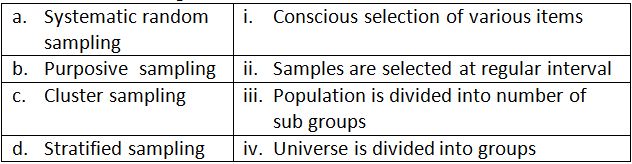
Answer : Option C
Explaination / Solution:
a. If a researcher wanted to create a systematic sample of 1,000 students at a university with an enrolled population of 10,000, he or she would choose every tenth person from a list of all students.
b. Data is selected based on characteristics of a population and the objective of the study.
c. The researcher first selects groups or clusters and then from each cluster, selects the individual subjects either by simple random sampling or systematic random sampling.
d. One might divide a sample of adults into subgroups by age, like 18-29, 30-39, 40-49, 50-59, and 60 and above. To stratify this sample, the researcher would then randomly select proportional amounts of people from each age group.
Q9. Board which investigate, collect and disseminate information relating to water, air and pollution, lay down standards of sewage/trade effluent and emissions
Answer : Option B
Explaination / Solution:
No Explaination.
Q10. Raising CRR by the central bank in India during excess demand will be
Answer : Option B
Explaination / Solution:
No Explaination.