Civil Engineering - Online Test
Q1. Consider the matrix as given below.

Which one of the following provides the CORRECT values of eigenvalues of the
matrix?
Answer : Option A
Explaination / Solution:
Given matrix is upper triangular matrix and its diagonal elements are its eigen values = 1, 4, 3
Q2. An application loads 100 libraries at startup. Loading each library requires exactly
one disk access. The seek time of the disk to a random location is given as 10ms.
Rotational speed of disk is 6000rpm. If all 100 libraries are loaded from random
locations on the disk, how long does it take to load all libraries? (The time to
transfer data from the disk block once the head has been positioned at the start
of the block may be neglected)
Answer : Option B
Explaination / Solution:
6000 rotations ________ 60 sec
1 rotation ________10 ms
Rotational latency = 5ms
Time for one disk access = 15 ms
Time to load all libraries = 15 ×100 = 1500ms = 1.5 sec
Q3. Given i = √−1, what will be the evaluation of the definite integral 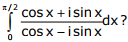
Answer : Option D
Explaination / Solution:

Q4. Consider a finite sequence of random values X = [x1, x2,...xn]. Let µx be the mean
and σx be the standard deviation of X .Let another finite sequence Y of equal
length be derived from this as yi = a* xi + b, where a and b are positive
constants. Let µy be the mean and σy be the standard deviation of this
sequence. Which one of the following statements is INCORRECT?
Answer : Option D
Explaination / Solution:
No Explaination.
Q5. A deck of 5 cards (each carrying a distinct number from 1 to 5) is shuffled
thoroughly. Two cards are then removed one at a time from the deck. What is
the probability that the two cards are selected with the number on the first card
being one higher than the number on the second card?
Answer : Option A
Explaination / Solution:
(2,1), (3,2), (4,3), (5,4)
Required probability = 4/(5×4) = 4/20 = 1/5
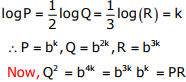
Q6. If Log (P) = (1/2)Log (Q) = (1/3) Log (R), then which of the following options is
TRUE?
Answer : Option B
Explaination / Solution:
Q7. P, Q, R and S are four types of dangerous microbes recently found in a human
habitat. The area of each circle with its diameter printed in brackets represents
the growth of a single microbe surviving human immunity system within 24 hours
of entering the body. The danger to human beings varies proportionately with the
toxicity, potency and growth attributed to a microbe shown in the figure
below 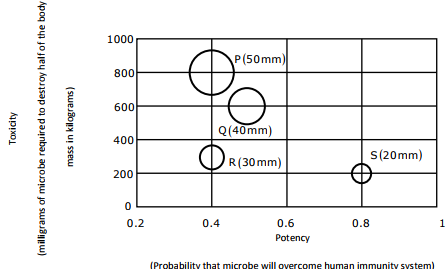
A pharmaceutical company is contemplating the development of a vaccine
against the most dangerous microbe. Which microbe should the company target
in its first attempt?
Answer : Option D
Explaination / Solution:
By observation of the table, we can say S

Q8. The variable cost (V) of manufacturing a product varies according to the equation
V= 4q, where q is the quantity produced. The fixed cost (F) of production of same
product reduces with q according to the equation F = 100/q. How many units
should be produced to minimize the total cost (V+F)?
Answer : Option A
Explaination / Solution:
Checking with all options in formula: (4q+100/q) i.e. (V+F). Option A gives the
minimum cost.
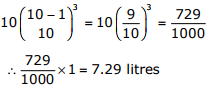
Q9. A container originally contains 10 litres of pure spirit. From this container 1 litre
of spirit is replaced with 1 litre of water. Subsequently, 1 litre of the mixture is
again replaced with 1 litre of water and this process is repeated one more time.
How much spirit is now left in the container?
Answer : Option D
Explaination / Solution:
Q10. Consider a random variable X that takes values + 1 and -1 with probability 0.5 each. The
values of the cumulative distribution function F(x) at x = -1 and +1 are
Answer : Option C
Explaination / Solution:
The cumulative distribution function
F(x) = P(X ≤ x)
F(-1) = P(X ≤ -1) = P(X = -1) = 0.5
F(+1) = P(X ≤ +1) = P(X = -1) + P(X = +1) = 0.5 + 0.5 = 1