Physics - Online Test
Q1. If the temperature of the wire is increased, then the Young’s modulus will
Answer : Option B
Explaination / Solution:
No Explaination.
Q2. The
V-T diagram of an ideal gas which goes through a reversible cycle A→B→C→D is
shown below. (Processes D→A and B→C are adiabatic)
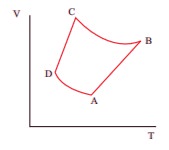
The
corresponding PV diagram for the process is (all figures are schematic)
Answer : Option B
Explaination / Solution:
No Explaination.
Q3. Which of the following shows the correct relationship between the pressure and density of an ideal gas at constant temperature?
Answer : Option D
Explaination / Solution:
No Explaination.
Q4. A
pendulum is hung in a very high building oscillates to and fro motion freely
like a simple harmonic oscillator. If the acceleration of the bob is 16 ms−2 at a distance of 4 m
from the mean position, then the time period is
Answer : Option D
Explaination / Solution:
No Explaination.
Q5. Consider
two uniform wires vibrating simultaneously in their fundamental notes. The
tensions, densities, lengths and diameter of the two wires are in the ratio 8 :
1, 1 : 2, x : y and 4 : 1 respectively. If the note of the higher pitch has a
frequency of 360 Hz and the number of beats produced per second is 10, then the
value of x : y is
Answer : Option A
Explaination / Solution:
No Explaination.
Q6. The dimensional formula for gravitational constant G is
Answer : Option B
Explaination / Solution:
No Explaination.
Q7. A ball is dropped from some height towards the ground. Which one of the following represents the correct motion of the ball?
Answer : Option A
Explaination / Solution:
No Explaination.
Q8. When the object is moving at constant velocity on the rough surface,
Answer : Option A
Explaination / Solution:
No Explaination.
Q9. If the potential energy of the particle is α -
β/2 x2, then force experienced by the particle is
Answer : Option C
Explaination / Solution:
No Explaination.
Q10. A disc of moment of inertia Ia is
rotating in a horizontal plane about its symmetry axis with a constant angular
speed ω. Another discinitially at rest of moment of inertia Ib is
dropped coaxially on to the rotating disc. Then, both the discs rotate with
same constant angular speed. The loss of kinetic energy due to friction in this
process is,
Answer : Option D
Explaination / Solution:
No Explaination.