Communication Engineering - Online Test
Q1. The block diagram of a frequency synthesizer consisting of a Phase Locked Loop (PLL) and a
divide-by-𝑁 counter (comprising ÷2, ÷4, ÷8, ÷16 outputs) is sketched below. The synthesizer is
excited with a 5 kHz signal (Input 1). The free-running frequency of the PLL is set to20 kHz.
Assume that the commutator switch makes contacts repeatedly in the order 1-2-3-4.
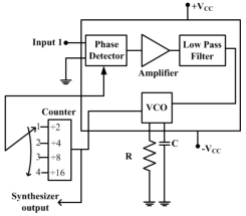
The corresponding frequencies synthesized are:
Answer : Option A
Explaination / Solution:
No Explaination.
Q2. A system is defined by its impulse response  The system is
The system is
Answer : Option B
Explaination / Solution:
No Explaination.
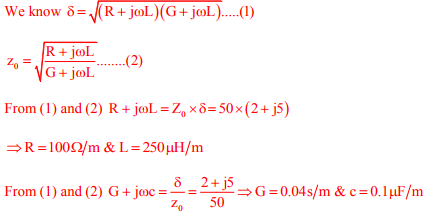
Q3. The propagation constant of a lossy transmission line is (2 + 𝑗5) m-1 and its characteristic impedance is (50 + j0)𝜔 at 𝜔 = 106 rad s-1. The values of the line constants L, C, R, G are, respectively,
Answer : Option B
Explaination / Solution:
Q4.
Assuming zero initial condition, the response y(t) of the system given below to a unit step input u(t) h is
Answer : Option B
Explaination / Solution:
The Laplace transform of unit step fun n is 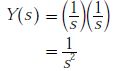


U(s)=1/s
So, the O/P of the system is given as
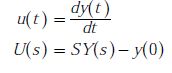
For zero initial condition, we check
Hence, the O/P is correct which is
its inverse Laplace transform is given by
Y(t)=tu(t)
Q5. An antenna pointing in a certain direction has a noise temperature of 50K. The ambient
temperature is 290 K. The antenna is connected to a pre-amplifier that has a noise figure of 2
dB and an available gain of 40 dB over an effective bandwidth of 12 MHz. The effective input
noise temperature Te for the amplifier and the noise power Pao at the output of the preamplifier,
respectively, are
Answer : Option A
Explaination / Solution:
No Explaination.
Q6. If the unit step response of a network is (1 – e-αt), then its unit impulse response is
Answer : Option A
Explaination / Solution:

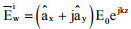
Q7. The electric field of a uniform plane wave travelling along the negative z direction is given by
the following equation:
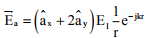
This wave is incident upon a receiving antenna placed at the origin and whose radiated electric
field towards the incident wave is given by the following equation:
The polarization of the incident wave, the polarization of the antenna and losses due to the
polarization mismatch are, respectively,
Answer : Option C
Explaination / Solution:
No Explaination.
Q8. An input  is applied to an LTI system with
impulse response h(t) = u(t). The output is
is applied to an LTI system with
impulse response h(t) = u(t). The output is
is applied to an LTI system with
impulse response h(t) = u(t). The output is
Answer : Option D
Explaination / Solution:
 and h(t) = u(t)
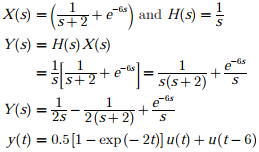
and h(t) = u(t)Taking Laplace Transform we get
Q9. The far-zone power density radiated by a helical antenna is approximated as:

The radiated power density is symmetrical with respect to ϕ and exists only in the upper
hemisphere: C0 is a constant. The power radiated by the antenna (in
watts) and the maximum directivity of the antenna, respectively, are
Answer : Option B
Explaination / Solution:
No Explaination.
Q10. Which one of the following is an eigen function of the class of all continuous-time, linear, time-invariant systems u(t) denotes the unit-step function)?
Answer : Option C
Explaination / Solution:
No Explaination.