Communication Engineering - Online Test
Q1. 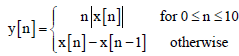
Consider a single input single output discrete-time system with x[n] as input and y[n] as output, where the two are related as
Which one of the following statements is true about the system?
Answer : Option A
Explaination / Solution:
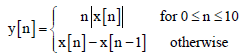
For an input-output relation if the present output depends on present and past input values then the given system is “Causal”.
For the given relation,
For n ranging from 0 to 10 present output depends on present input only.
At all other points present output depends on present and past input values.
Thus the system is “Causal”.
Stability
If x[n] is bounded for the given finite range of n i.e. 0 ≤ n ≤ 10 y[n] is also bounded.
Similarly x[n] - x[n-1] is also bounded at all other values of n
Thus the system is “stable”.
Q2. A message signal m(t) = cos 200πt + 4cosπt modulates the carrier
c(t) = coe 2πfct where fc = 1MHz to produce an AM signal. For demodulating
the generated AM signal using an envelope detector, the time constant RC of
the detector circuit should satisfy
Answer : Option B
Explaination / Solution:
Highest frequency component in m(t) is 

Carrier frequency fc = 1 MHz
For Envelope detector condition
Q3. Let x(t) be a continuous time periodic signal with fundamental period T = 1 seconds. Let {ak} be the complex Fourier series coefficients of x(t), where k is integer valued. Consider the following statements about x(3t):
I. The complex Fourier series coefficients of x(3t) are {ak} where k is integer valued
II. The complex Fourier series coefficients of x(3t) are {3ak} where k is integer valued
III. The fundamental angular frequency of x(3t) is 6𝜋 rad/s
For the three statements above, which one of the following is correct?
Answer : Option B
Explaination / Solution:
Fourier series coefficient ak is unaffected by scaling operating. Thus (I) is true and (II) is false.
T = 1sec for x(t) and if it compressed by '3' then the resultant period T = 1/3
Fundamental frequency = 2𝜋/T1= = 6𝜋 rad/sec
Thus (III) is correct.
Q4. The result of the convolution  is
is
is
Answer : Option D
Explaination / Solution:
From the convolution property,


Now, we replace t by -t to obtain
Q5. In the circuit shown below, the network N is described by the following Y matrix: 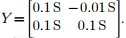 the voltage gain (V2/V1)is
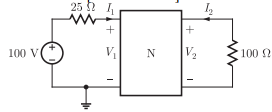
the voltage gain (V2/V1)is
Answer : Option D
Explaination / Solution:
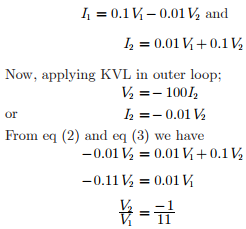
From given admittance matrix we get
Q6. A discrete time signal x[n] = sin (π2n) n being an integer, is
Answer : Option D
Explaination / Solution:
In the given options (A), (B) and (C), we have the periods respectively as
N1 = π
N2 = π2
N3 = π/3
None of the above period is an integer. Since, a discrete time signal has its period
an integer. So, all the three options are incorrect. Hence, we are left with the
option (D). i.e. the discrete time signal x[n] = sin (π2n) is not periodic.
Q7. A four-phase and an eight-phase signal constellation are shown in the figure
below.
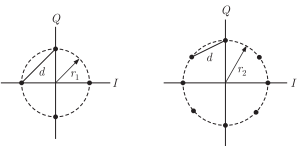
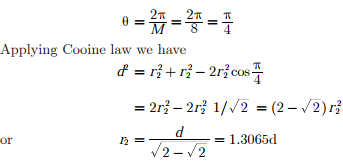
For the constraint that the minimum distance between pairs of signal points be
d for both constellations, the radii r1, and r2 of the circles are
Answer : Option D
Explaination / Solution:
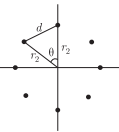
Four phase signal constellation is shown below
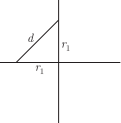
d2 = r12 + r12
d2 = 2r12
r1 = d/√2 = 0.707d
Q8.
Two systems with impulse responses h1(t) and h2(t) are connected in cascade. Then the overall impulse response of the cascaded system is given by
Answer : Option C
Explaination / Solution:
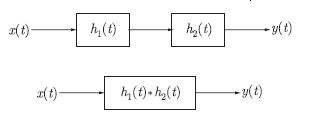
If the two systems with impulse responseh1(t) and h2(t) are connected in cascaded configuration as shown in figure, then the overall response of the system is the convolution of the individual impulse responses.
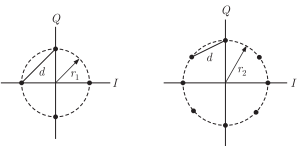
Q9. A four-phase and an eight-phase signal constellation are shown in the figure
below.
Assuming high SNR and that all signals are equally probable, the additional
average transmitted signal energy required by the 8-PSK signal to achieve the
same error probability as the 4-PSK signal is
Answer : Option D
Explaination / Solution:
Here Pe for 4 PSK and 8 PSK is same because Pe depends on d . Since Pe is same,
d is same for 4 PSK and 8 PSK.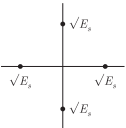
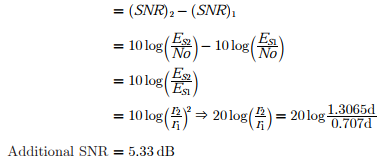
Additional Power SNR
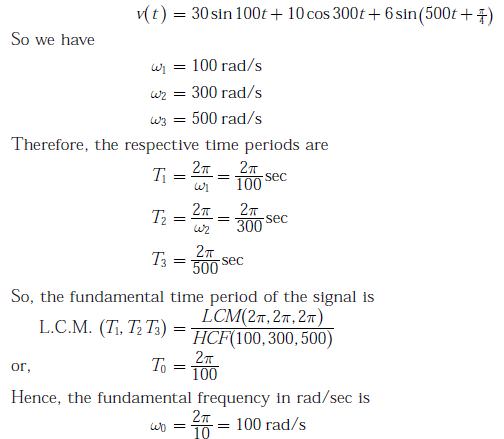
Q10. For a periodic signal  the fundamental frequency in rad/s
the fundamental frequency in rad/s
Answer : Option A
Explaination / Solution:
Given, the signal