Signals and Systems - Online Test
Q1. 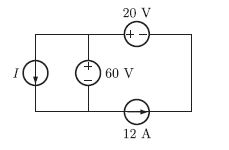
In the interconnection of ideal sources shown in the figure, it is known that the 60 V source is absorbing power.
Which of the following can be the value of the current source I ?
Answer : Option A
Explaination / Solution:
Circuit is as shown below
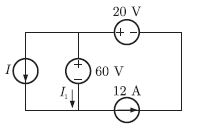
Since 60 V source is absorbing power. So, in 60 V source current flows from + to - ve direction So,
I + I1 = 12
I = 12 - I1
I is always less then 12 A So, only option (A) satisfies this conditions.
Q2. Let x(t) be a continuous time periodic signal with fundamental period T = 1 seconds. Let {ak} be the complex Fourier series coefficients of x(t), where k is integer valued. Consider the following statements about x(3t):
I. The complex Fourier series coefficients of x(3t) are {ak} where k is integer valued
II. The complex Fourier series coefficients of x(3t) are {3ak} where k is integer valued
III. The fundamental angular frequency of x(3t) is 6𝜋 rad/s
For the three statements above, which one of the following is correct?
Answer : Option B
Explaination / Solution:
Fourier series coefficient ak is unaffected by scaling operating. Thus (I) is true and (II) is false.
T = 1sec for x(t) and if it compressed by '3' then the resultant period T = 1/3
Fundamental frequency = 2𝜋/T1= = 6𝜋 rad/sec
Thus (III) is correct.
Q3. The result of the convolution  is
is
is
Answer : Option D
Explaination / Solution:
From the convolution property,


Now, we replace t by -t to obtain
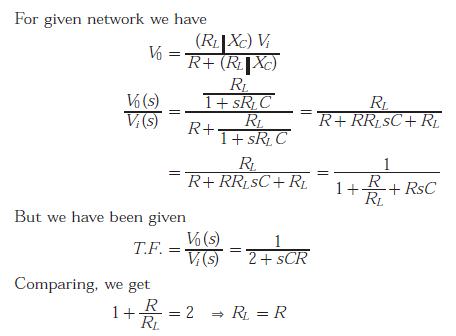
Q4. If the transfer function of the following network is
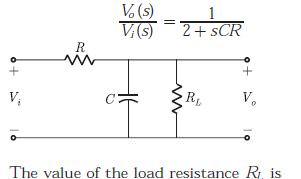
Answer : Option C
Explaination / Solution:
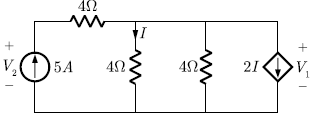
Q5. In the given circuit, the values of V1 and V2 respectively are
Answer : Option A
Explaination / Solution:
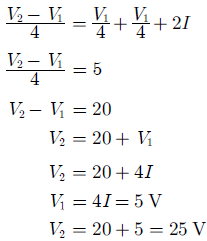
By Nodal analysis
Q6. A discrete time signal x[n] = sin (π2n) n being an integer, is
Answer : Option D
Explaination / Solution:
In the given options (A), (B) and (C), we have the periods respectively as
N1 = π
N2 = π2
N3 = π/3
None of the above period is an integer. Since, a discrete time signal has its period
an integer. So, all the three options are incorrect. Hence, we are left with the
option (D). i.e. the discrete time signal x[n] = sin (π2n) is not periodic.
Q7. A function 1 – x2 + x3 is defined in the closed interval [-1, 1]. The value of x , in the open interval (-1, 1) for which the mean value theorem is satisfied, is
Answer : Option B
Explaination / Solution:
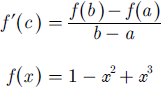
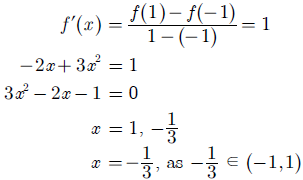
Lagrange’s mean value theorem states that if a function f(x) is continuous in close interval [a, b] and differentiable in open interval (a + b), then for point c in the interval, we may define
Since, polynomial function is always continuous and differentiable, so
Q8.
Two systems with impulse responses h1(t) and h2(t) are connected in cascade. Then the overall impulse response of the cascaded system is given by
Answer : Option C
Explaination / Solution:
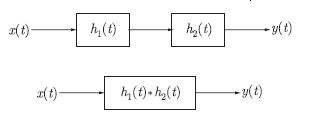
If the two systems with impulse responseh1(t) and h2(t) are connected in cascaded configuration as shown in figure, then the overall response of the system is the convolution of the individual impulse responses.
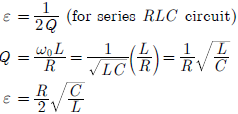
Q9. The damping ratio of a series RLC circuit can be expressed as
Answer : Option C
Explaination / Solution:
Damping ratio is given by
Q10. For a periodic signal  the fundamental frequency in rad/s
the fundamental frequency in rad/s
Answer : Option A
Explaination / Solution:
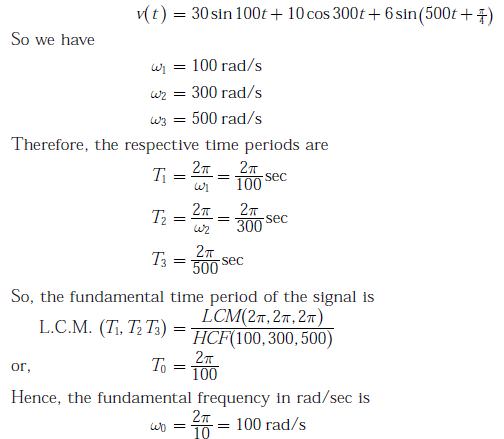
Given, the signal