Signals and Systems - Online Test
Q1.
Let x(t) be the input and y(t) be the output of a continuous time system.
Match the system properties P1, P2 and P3 with system relations R1, R2, R3, R4
Properties Relations
P1 : Linear but NOT time - invariant R1 : y(t) = t2x(t)
P2 : Time - invariant but NOT linear R2 : y(t) = t|x(t)|
P3 : Linear and time - invariant R3 : y(t) = |x(t)|
R4 : y(t) = x(t-5)
Answer : Option B
Explaination / Solution:
Mode function are not linear. Thus y(t) = |x(t)| is not linear but this functions is
time invariant. Option (A) and (B) may be correct.
The y(t) = t|x(t)| is not linear, thus option (B) is wrong and (a) is correct. We
can see that
R1 : y(t) = t2x(t) Linear and time variant.
R2 : y(t) = t|x(t)| Non linear and time variant.
R3 : y(t) = |x(t)| Non linear and time invariant.
R4 : y(t) = x(t-5) Linear and time invariant.
Q2. 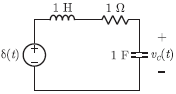
The following series RLC circuit with zero conditions is excited by a unit impulse functions 𝛿(t).
For t > 0, the output voltage vc(t) is
Answer : Option D
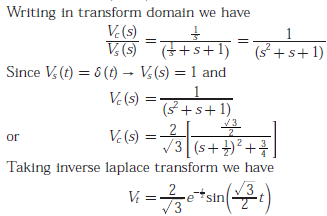
Explaination / Solution:
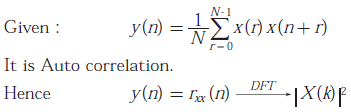
Q3. { x(n)} is a real - valued periodic sequence with a period N . x(n) and X(k) form N-point Discrete Fourier Transform (DFT) pairs. The DFT Y(k) of the sequence 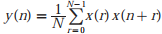 is
is
is
Answer : Option A
Explaination / Solution:
Q4. 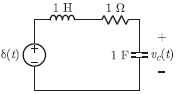
The following series RLC circuit with zero conditions is excited by a unit impulse functions 𝛿(t).
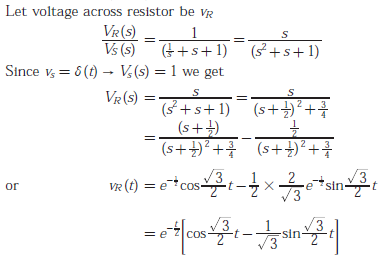
For t > 0, the voltage across the resistor is
Answer : Option B
Explaination / Solution:
Q5. 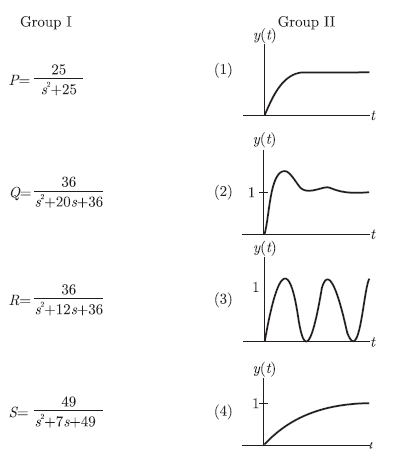
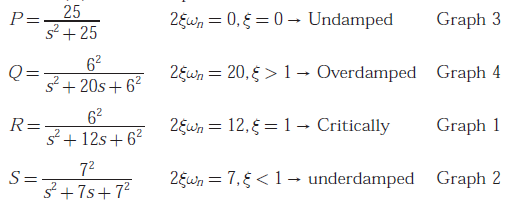
Group I lists a set of four transfer functions. Group II gives a list of possible step response y(t). Match the step responses with the corresponding transfer functions.
Answer : Option D
Explaination / Solution:
Q6. 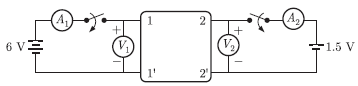

A two-port network shown below is excited by external DC source. The voltage and the current are measured with voltmeters V1,V2 and ammeters. A1,A2 (all assumed to be ideal), as indicated
Under following conditions, the readings obtained are:
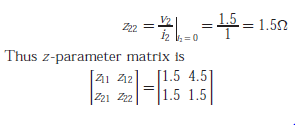
The z -parameter matrix for this network is
Answer : Option C
Explaination / Solution:
From the problem statement we have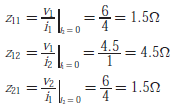
Q7. The Fourier series of a real periodic function has only (P) cosine terms if it is even (Q) sine terms if it is even (R) cosine terms if it is odd (S) sine terms if it is odd Which of the above statements are correct ?
Answer : Option A
Explaination / Solution:
The Fourier series of a real periodic function has only cosine terms if it is even and sine terms if it is odd.
Q8.
A two-port network shown below is excited by external DC source. The voltage and the current are measured with voltmeters V1,V2 and ammeters. A1,A2 (all assumed to be ideal), as indicated
Under following conditions, the readings obtained are:
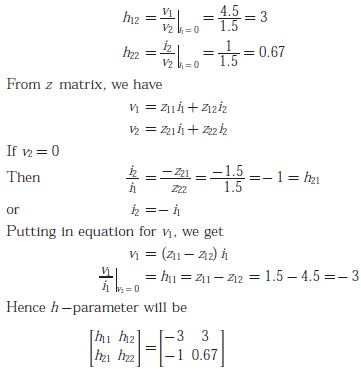
The h-parameter matrix for this network is
Answer : Option A
Explaination / Solution:
From the problem statement we have
Q9. The ROC of z -transform of the discrete time sequence 
Answer : Option A
Explaination / Solution:

Taking z transform we have

Taking z transform we have
Q10. 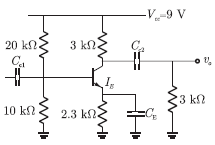
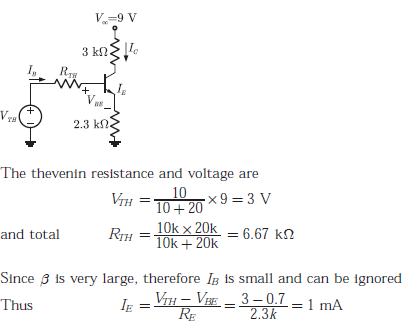
In the following transistor circuit,  , and 𝛽 and all the capacitances are very large
, and 𝛽 and all the capacitances are very largeThe value of DC current IE is
Answer : Option A
Explaination / Solution:
For the given DC values the Thevenin equivalent circuit is as follows