Probability and Statistics - Online Test
Q1. An urn contains 5 red and 2 black balls. Two balls are randomly drawn. Let X represent the number of black balls. What are the possible values of X? Is X a random variable ?
Answer : Option C
Explaination / Solution:
An urn contains 5 red and 2 black balls. Two balls are randomly drawn. Let X represent the number of black balls.therefore the possible values of X = 0 , 1 ,2 . Yes , X is a random variable.
Q2. Let X represent the difference between the number of heads and the number of tails obtained when a coin is tossed 6 times. What are possible values of X?
Answer : Option A
Explaination / Solution:
Let X represent the difference between the number of heads and the number of tails obtained when a coin is tossed 6 times. When a coin is tossed 6 times , we have 64 outcomes which consists of : (i) 6 heads and 0 tails (ii) 5 heads and 1 tail (iii) 4 heads and 2 tails (iv) 3 heads and 3 tails (v) 2 heads and 4 tails (vi) 1 head and 5 tails (vii) 0 head and 6 tails . Let X represents the difference between the number of heads and tails. (i) X = 6 – 0 = 6 (ii) X = 5 – 1 = 4 (iii) X = 4 – 2 = 2 (iv) X = 3 – 3 = 0 (v) X = 4 – 2 = 2 (vi) X = 5 – 1 = 4 (vii) X = 6 – 0 = 6 . Therefore , X = 6 , 4 , 2, 0 .
Q3. Find the mean number of heads in three tosses of a fair coin.
Answer : Option C
Explaination / Solution:
Let X is the random variable of “number of heads “ X = 0, 1, 2, 3.
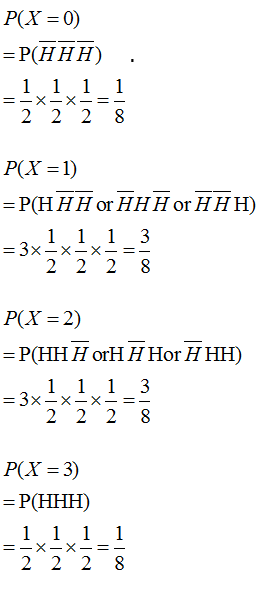
Therefore, the probability distribution is:
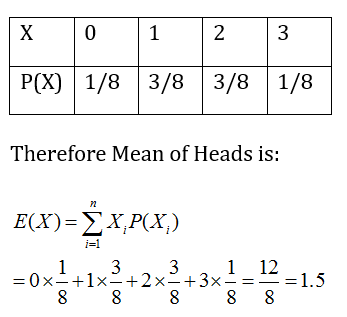
Therefore, the probability distribution is:
Q4. Two dice are thrown simultaneously. If X denotes the number of sixes, find the expectation of X.
Answer : Option B
Explaination / Solution:
Let A = event of getting 6 on the dice .
A = {(6,1),(6,2),(6,3),(6,4),(6,5),(6,6),(1,6),(2,6),(3,6),(4,6),(5,6)}
Let X is the random variable of “ number of sixes “.
Therefore, X = 0 , 1, ,2 .
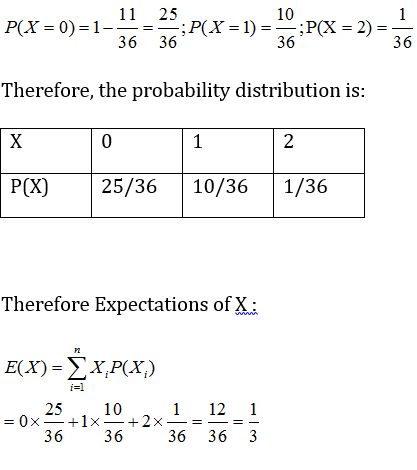
A = {(6,1),(6,2),(6,3),(6,4),(6,5),(6,6),(1,6),(2,6),(3,6),(4,6),(5,6)}
Let X is the random variable of “ number of sixes “.
Therefore, X = 0 , 1, ,2 .
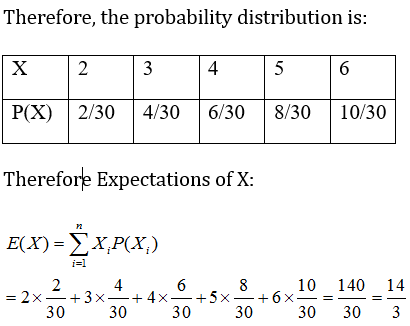
Q5. Two numbers are selected at random (without replacement) from the first six positive integers. Let X denote the larger of the two numbers obtained. Find E(X).
Answer : Option B
Explaination / Solution:
First 6 positive integers are 1,2,3,4,5,6. As 1 is the smallest positive integer. Therefore , X = 2,3,4,5,6.
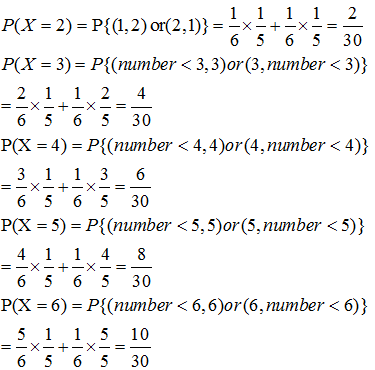
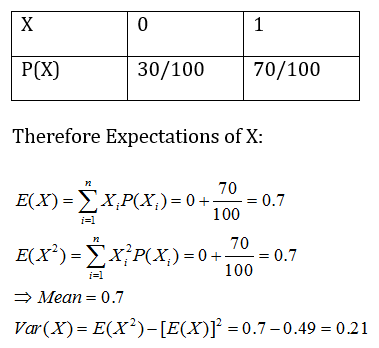
Q6. In a meeting, 70% of the members favour and 30% oppose a certain proposal.A member is selected at random and we take X = 0 if he opposed, and X = 1 if he is in favour. Find E(X) and Var (X).
Answer : Option C
Explaination / Solution:
Here X = 0, 1.
Therefore, the probability distribution is:
Therefore, the probability distribution is: