Mechanical Engineering - Online Test
Q1. Consider the system

where p and q are arbitrary real numbers. Which of the following statements about the controllability of the system is true ?
Answer : Option C
Explaination / Solution:
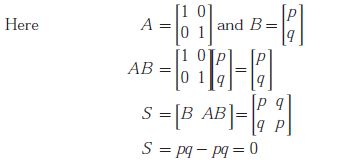
Since S is singular, system is completely uncontrollable for all values of p and q .
Q2. A solid shaft of diameter, d and length L is fixed at both the ends. A torque, T0 is applied at a
distance, L/4 from the left end as shown in the figure given below.
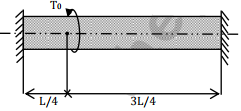
The maximum shear stress in the shaft is
Answer : Option B
Explaination / Solution:
No Explaination.
Q3. The inlet and the outlet conditions of steam for an adiabatic steam turbine are as indicated in the notations are as usually followed
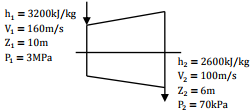
Assume the above turbine to be part of a simple Rankine cycle. The density of water at the inlet to
the pump is 1000kg/m3. Ignoring kinetic and potential energy effects, the specific work (in kJ/kg)
supplied to the pump is
Answer : Option C
Explaination / Solution:
No Explaination.
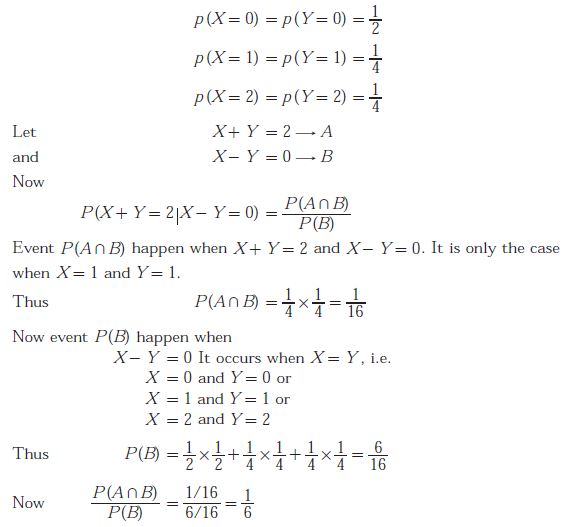
Q4. Consider two independent random variables X and Y with identical distributions. The variables X and Y take values 0, 1 and 2 with probabilities 1/2,1/4 and 1/4 respectively. What is the conditional probability P(X + Y = 2 X - Y = 0) ?
Answer : Option C
Explaination / Solution:
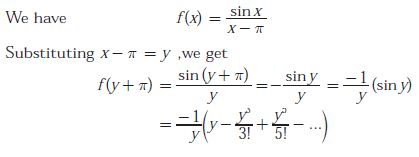
We have
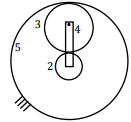
Q5. An epicyclic gear train is shown schematically in the adjacent figure. The sun gear 2 on the input
shaft is a 20 teeth external gear. The planet gear 3 is a 40 teeth external gear. The ring gear 5 is a
100 teeth internal gear. The ring gear 5 is fixed and the gear 2 is rotating at 60 rpm ccw (ccw =
counter-clockwise and cw = clockwise). The arm 4 attached to the output shaft will rotate at
Answer : Option A
Explaination / Solution:
No Explaination.
Q6. Radiative heat transfer is intended between the inner surfaces of two very large isothermal parallel metal plates. While the upper plate (designated as plate 1) is a black surface and the warmer one being maintained at 727oC, the lower plate ( plate 2) is a diffuse and gray surface with an emissivity of 0.7 and is kept at 227oC. Assume that the surfaces are sufficiently large to form a two-surface enclosure and steady state conditions to exist. Stefan Boltzmann constant is given as 5.67 × 10⁻⁸ W/m2K4
The irradiation (in kW/m2) for the upper plate (plate 1) is
Answer : Option A
Explaination / Solution:
No Explaination.
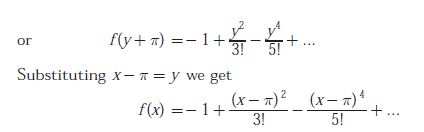
Q7. The Taylor series expansion of 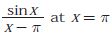 is given by
is given by
Answer : Option D
Explaination / Solution:
Q8. A forged steel link with uniform diameter of 30mm at the centre is subjected to an axial force that
varies from 40kN in compression to 160kN in tension. The tensile (Su), yield (Sy) and corrected
endurance (Se) strengths of the steel material are 600MPa, 420MPa and 240MPa respectively. The
factor of safety against fatigue endurance s per Soderberg’s criterion is
Answer : Option D
Explaination / Solution:
No Explaination.
Q9. Radiative heat transfer is intended between the inner surfaces of two very large isothermal parallel metal plates. While the upper plate (designated as plate 1) is a black surface and the warmer one being maintained at 727oC, the lower plate ( plate 2) is a diffuse and gray surface with an emissivity of 0.7 and is kept at 227oC. Assume that the surfaces are sufficiently large to form a two-surface enclosure and steady state conditions to exist. Stefan Boltzmann constant is given as 5.67 × 10⁻⁸ W/m2K4
If plate 1 is also a diffuse and gray surface with an emissivity value of 0.8, the net radiation heat
exchange (in kW/m2) between plate 1 and plate 2 is
Answer : Option D
Explaination / Solution:
No Explaination.
Q10. Given that F(s) is the one-side Laplace transform of f (t), the Laplace transform 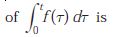
Answer : Option B
Explaination / Solution:
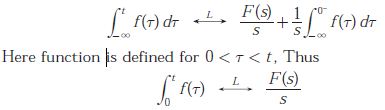
By property of unilateral laplace transform