Mechanical Engineering - Online Test
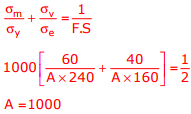
Q1. A bar is subjected to fluctuating tensile load from 20 kN to 100 kN. The material
has yield strength of 240 MPa and endurance limit in reversed bending is 160
MPa. According to the Soderberg principle, the area of cross-section in mm2 of
the bar for a factor of safety of 2 is
Answer : Option D
Explaination / Solution:
Q2. Consider steady, incompressible and irrotational flow through a reducer in a horizontal pipe
where the diameter is reduced from 20cm to 10cm. The pressure in the 20cm pipe just upstream
of the reducer is 150 kPa. The fluid has a vapour pressure of 50kPa and a specific weight of 5
kN/m3. Neglecting frictional effects, the maximum discharge (in m3/s) that can pass through the
reducer without causing cavitation is
Answer : Option B
Explaination / Solution:
No Explaination.
Q3. A function n(x) satisfied the differential equation 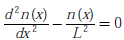 where L is a constant. The boundary conditions are :n(0) = K and n(∞) = 0. The solution to this equation is
where L is a constant. The boundary conditions are :n(0) = K and n(∞) = 0. The solution to this equation is
Answer : Option D
Explaination / Solution:
Given differential equation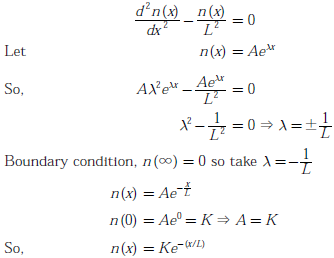
Q4. A simply supported beam of length L is subjected to a varying distributed load 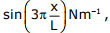 where the distance x is measured from the left support. The
magnitude of the vertical force in N at the left support is
where the distance x is measured from the left support. The
magnitude of the vertical force in N at the left support is
where the distance x is measured from the left support. The
magnitude of the vertical force in N at the left support is
Answer : Option B
Explaination / Solution:
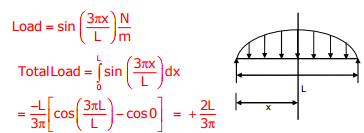
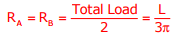
Since the load is distributed equally on both supports
Q5. A single riveted lap joint of two similar plates as shown in the figure below has
the following geometrical and material details: 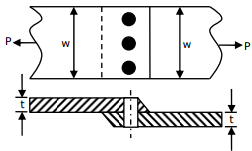
Width of the plate w=200 mm, thickness of the plate t=5 mm, number of rivets
n=3, diameter of the rivet dr = 10mm, diameter of the rivet hole dh = 11mm, allowable tensile stress of the plate σp = 200 MPa, allowable shear stress of the
rivet σs = 100 MPa and allowable bearing stress of the σc = 150 MPa
If the rivets are to be designed to avoid crushing failure, the maximum
permissible load P in kN is
Answer : Option C
Explaination / Solution:
No Explaination.
Q6. In a parallel flow heat exchanger operating under steady state, the heat capacity rates (product of
specific heat at constant pressure and mass flow rate) of the hot and cold fluid are equal. The hot
fluid, flowing at 1 kg/s with Cp= 4kJ/kgK, enters the heat exchanger at 102°C, while the cold fluid
has an inlet temperature of 15°C. The overall heat transfer coefficient for the heat exchanger is
estimated to be 1kW/m2K and the corresponding heat transfer surface area is 5m2. Neglect heat
transfer between the heat exchanger and the ambient. The heat exchanger is characterized by the
following relation: 2ε = 1 - exp(-2NTU). The exit temperature (in °C) for the cold fluid is
Answer : Option B
Explaination / Solution:
No Explaination.
Q7. Consider the z -transform  The inverse z -transform x[n] is
The inverse z -transform x[n] is
Answer : Option A
Explaination / Solution:

Q8. A single riveted lap joint of two similar plates as shown in the figure below has the following geometrical and material details:
Width of the plate w=200 mm, thickness of the plate t=5 mm, number of rivets n=3, diameter of the rivet dr = 10mm, diameter of the rivet hole dh = 11mm, allowable tensile stress of the plate σp = 200 MPa, allowable shear stress of the rivet σs = 100 MPa and allowable bearing stress of the σc = 150 MPa
If the plates are to be designed to avoid tearing failure, the maximum
permissible load P in kN is
Answer : Option C
Explaination / Solution:
No Explaination.
Q9. In an air-standard Otto cycle, the compression ratio is 10. The condition at the beginning of the
compression process is 100kPa and 27oC. Heat added at constant volume is 1500 kJ/kg, while
700 kJ/kg of heat is rejected during the other constant volume process in the cycle. Specific gas
constant for air = 0.287kJ/kgK. The mean effective pressure (in kPa) of the cycle is
Answer : Option D
Explaination / Solution:
No Explaination.
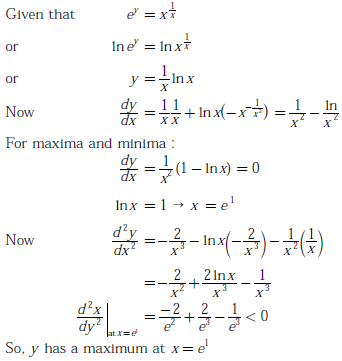
Q10. If ey = x1/x , then y has a
Answer : Option A
Explaination / Solution: