Mechanical Engineering - Online Test
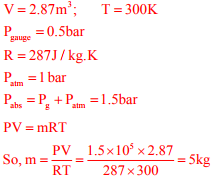
Q1. The volume and temperature of air (assumed to be an ideal gas) in a closed vessel is 2.87 m3 and 300K, respectively. The gauge pressure indicated by a manometer fitted to the wall of the
vessel is 0.5bar. If the gas constant of air is R = 287 J/kg. K and the atmospheric pressure is 1
bar, the mass of air (in kg) in the vessel is
Answer : Option C
Explaination / Solution:
Q2. Holes of diameter  mm are assembled interchangeably with the pins of diameter
  mm. The minimum clearance in the assembly will be
mm are assembled interchangeably with the pins of diameter mm. The minimum clearance in the assembly will be
Answer : Option B
Explaination / Solution:
Minimum clearance
minimu m hole - maxium shaft
= 25 + .020 - 25 + .005
= 0.015 mm
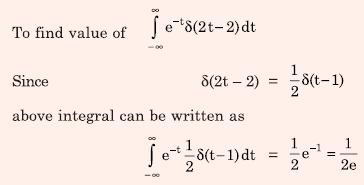
Q3. The value of  where δ(t) is the Dirac delta function, is
where δ(t) is the Dirac delta function, is
Answer : Option A
Explaination / Solution:
Q4. Consider a laminar flow at zero incidence over a flat plate. The shear stress at the wall is
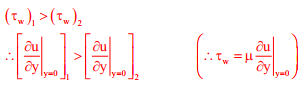
denoted by τw. The axial positions x1 and x2 on the plate are measured from the leading edge
in the direction of flow. If x2 > x1, then
Answer : Option C
Explaination / Solution:
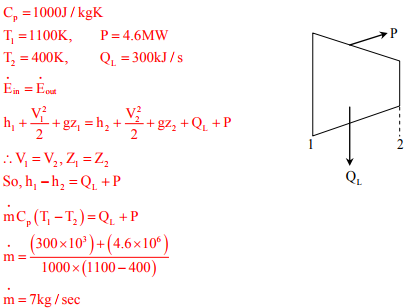
Q5. A calorically perfect gas (specific heat at constant pressure 1000 J/kg.K) enters and leaves a gas
turbine with the same velocity. The temperatures of the gas at turbine entry and exit are 1100 K
and 400 K. respectively. The power produced is 4.6 MW and heat escapes at the rate of 300 kJ/s
through the turbine casing. The mass flow rate of the gas (in kg/s) through the turbine is.
Answer : Option B
Explaination / Solution:
Q6. Match the following products with preferred manufacturing processes:
Product Process
P Rails (1)Blow
molding
Q Engine crankshaft (2) Extrusion
R Aluminium channels (3) Forging
S PET water bottles (4) Rolling
Answer : Option B
Explaination / Solution:
No Explaination.
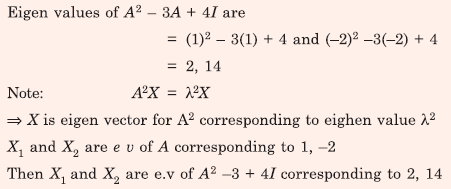
Q7. Let the eigenvalues of a 2 x 2 matrix A be 1, -2 with eigenvectors x1 and x2 respectively. Then the eigenvalues and eigenvectors of the matrix A2 − 3A + 4I would, respectively, be
Answer : Option A
Explaination / Solution:
Q8. 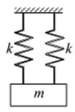
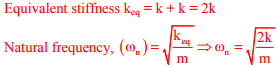
A mass m is attached to two identical springs having spring constant k as shown in the figure. The natural frequency 𝜔 of this single degree of freedom system is
Answer : Option A
Explaination / Solution:
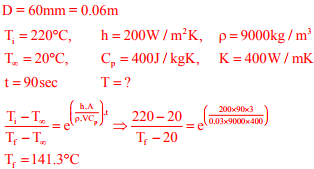
Q9. A metal ball of diameter 60mm is initially at 220 °C. The ball is suddenly cooled by an air jet
of 20°C. The heat transfer coefficient is 200 W/m2. K and 9000kg/m3, respectively. The ball
temperature (in °C) after 90 seconds will be approximately.
Answer : Option A
Explaination / Solution:
Q10. Which one of the following is the most conservative fatigue failure criterion?
Answer : Option A
Explaination / Solution:
No Explaination.