Agriculture - Online Test
Q1. In T. H. Morgan"s Experiment on Drosophilia what will be the result when F1 female flies are crossed with double recessive male files?
Answer : Option A
Explaination / Solution:
When F1 female flies (Drosophila) obtained in crossed with double recessive male flies 83% parental combination are obtained along with 17% recombinant offspring are formed.
Q2. Glycolysis is conversion of
Answer : Option D
Explaination / Solution:
Glycolysis is the metabolic pathway that converts glucose C6H12O6, into pyruvate, CH3COCOO− + H+.
The free energy released in this process is used to form the high-energy molecules ATP (adenosine triphosphate) and NADH (reduced nicotinamide adenine dinucleotide).
Q3. Parallel venation is present in
Answer : Option D
Explaination / Solution:
Parallel venation is the characteristic features of monocots. Dicots possesses reticulate venation. The arrangementof veins on leaf is called venation.
Q4. Identify “A” and “B” in the T.S of mature anther
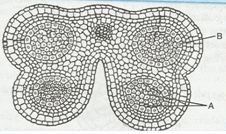
Answer : Option D
Explaination / Solution:
The mature anther consists of four microsporangia which contain four layers. The inner most layer is called tapetum that provide nutrient to growing microspores and tissues inside it are called microspore mother cell that produce pollen grain.
Q5. In angiosperms vascular tissue develop from
Answer : Option D
Explaination / Solution:
In angiosperms vascular tissue develop from plerome. Plerome form the central core of the primary meristem of a plant or plant part.
Q6. Permanent and irreversible increase in dry weight, size, and mass, volume of cell, organ or organism is called
Answer : Option C
Explaination / Solution:
Growth is defined as a permanent or irreversible increase in dry weight, size, mass or volume of a cell, organ or organism. Growth in living beings is intrinsic or internal.
Q7. Water hyacinth is called as terror of Bengal due to
Answer : Option C
Explaination / Solution:
Water hyacinth is water weeds which grows very fast and covers the whole ponds in few days. Weeds absorb oxygen from the water and make it oxygen deficient that kills the fish in ponds along with other aquatic organisms.
Q8. Water potential of pure water and its solution are
Answer : Option B
Explaination / Solution:
The water potential of pure water at standard temperatures, which is not under any pressure, is taken to be zero. If some solute is dissolved in pure water, the solution has fewer free water and the concentration of water decreases, reducing its water potential.
Q9. In plant, nitrate is reduced to ammonia state in two steps. In second step electrons are donated by
Answer : Option B
Explaination / Solution:
During ammonification process involve conversion of nitrate into ammonia. This process involves two steps. Second steps require electron that is donated by Ferredoxin.
Q10. Which of the following is responsible for peat formation?
Answer : Option D
Explaination / Solution:
Sphagnum mosses not only dominate large areas of the boreal peatlands, but they have also formed these habitats by their growth and production of decay-resistant litter. As they invade, they can quickly transform a high-pH fen with little peat accumulation to a bog where large amounts of carbon is stored. They are also responsible for the many types of surface patterns observed in peatlands. Their ability to shape and transform mires can to a large extent be understood from the peculiar anatomy and biochemistry, a fact which makes the links between species’ traits and ecosystem functions in peatlands very strong.