Communication Engineering - Online Test
Q1. 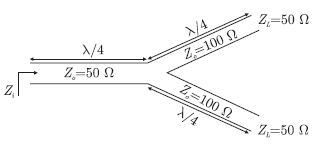
A transmission line terminates in two branches, each of length  as shown. The branches are terminated by 50W loads. The lines are lossless and have the characteristic impedances shown. Determine the impedance Zi as seen by the source.
as shown. The branches are terminated by 50W loads. The lines are lossless and have the characteristic impedances shown. Determine the impedance Zi as seen by the source.
Answer : Option D
Explaination / Solution:
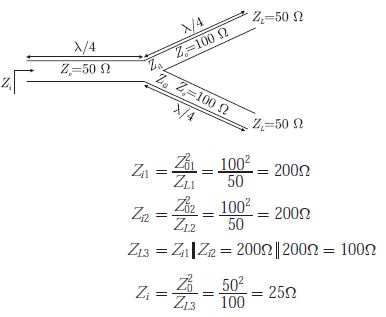
The transmission line are as shown below. Length of all line is 
Q2.
Let x(t) be the input and y(t) be the output of a continuous time system.
Match the system properties P1, P2 and P3 with system relations R1, R2, R3, R4
Properties Relations
P1 : Linear but NOT time - invariant R1 : y(t) = t2x(t)
P2 : Time - invariant but NOT linear R2 : y(t) = t|x(t)|
P3 : Linear and time - invariant R3 : y(t) = |x(t)|
R4 : y(t) = x(t-5)
Answer : Option B
Explaination / Solution:
Mode function are not linear. Thus y(t) = |x(t)| is not linear but this functions is
time invariant. Option (A) and (B) may be correct.
The y(t) = t|x(t)| is not linear, thus option (B) is wrong and (a) is correct. We
can see that
R1 : y(t) = t2x(t) Linear and time variant.
R2 : y(t) = t|x(t)| Non linear and time variant.
R3 : y(t) = |x(t)| Non linear and time invariant.
R4 : y(t) = x(t-5) Linear and time invariant.
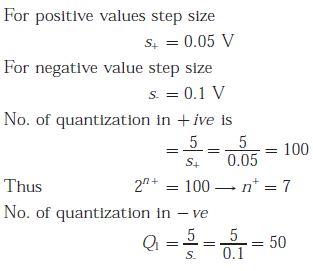
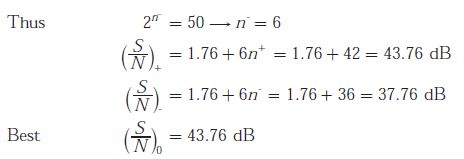
Q3. The amplitude of a random signal is uniformly distributed between -5 V and 5 V.If the signal to quantization noise ratio required in uniformly quantizing the signal is 43.5 dB, the step of the quantization is approximately
Answer : Option C
Explaination / Solution:
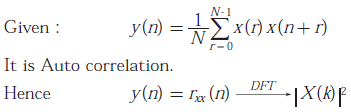
Q4. { x(n)} is a real - valued periodic sequence with a period N . x(n) and X(k) form N-point Discrete Fourier Transform (DFT) pairs. The DFT Y(k) of the sequence 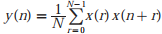 is
is
is
Answer : Option A
Explaination / Solution:
Q5. The maximum value of ᶿ until which the approximation sin ᶿ=ᶿ holds to within 10% error is
Answer : Option B
Explaination / Solution:
Here, as we know
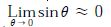
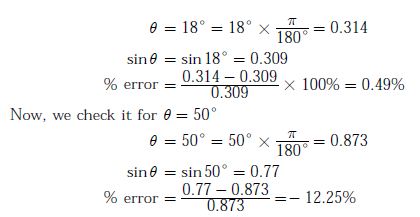
but for 10% error, we can check option (B) first
so, the error is more than 10%. Hence, for error less than 10%, ᶿ = 18º can have the approximation
Q6. 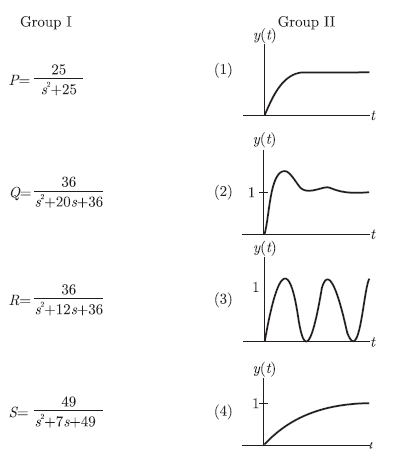
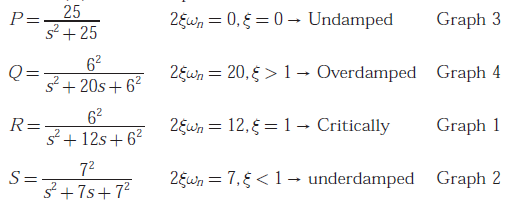
Group I lists a set of four transfer functions. Group II gives a list of possible step response y(t). Match the step responses with the corresponding transfer functions.
Answer : Option D
Explaination / Solution:
Q7.
The bit rate of a digital communication system is R kbits/s. The modulation used is 32-QAM. The minimum bandwidth required for ISI free transmission is
Answer : Option B
Explaination / Solution:

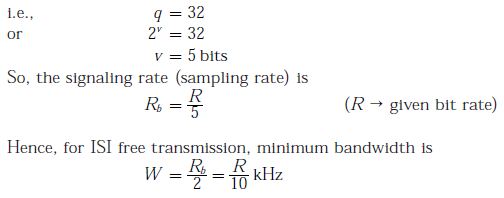
In ideal Nyquist Channel, bandwidth required for ISI (Inter Symbol reference) free transmission is
Here, the used modulation is 32 - QAM (Quantum Amplitude modulation
Q8. The Fourier series of a real periodic function has only (P) cosine terms if it is even (Q) sine terms if it is even (R) cosine terms if it is odd (S) sine terms if it is odd Which of the above statements are correct ?
Answer : Option A
Explaination / Solution:
The Fourier series of a real periodic function has only cosine terms if it is even and sine terms if it is odd.
Q9.
A band-limited signal with a maximum frequency of 5 kHz is to be sampled. According to the sampling theorem, the sampling frequency which is not valid
Answer : Option A
Explaination / Solution:
Given, the maximum frequency of the band-limited signal

fm = 5 kHz
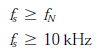
According to the Nyquist sampling theorem, the sampling frequency must be greater than the Nyquist frequency which is given as
So, the sampling frequency fs must satisfy
only the option (A) does’nt satisfy the condition therefore, 5K HZ is not a valid sampling frequency.
Q10. The ROC of z -transform of the discrete time sequence 
Answer : Option A
Explaination / Solution:

Taking z transform we have

Taking z transform we have