Networks, Signals and Systems - Online Test
Q1. Which one of the following is an eigen function of the class of all continuous-time, linear, time-invariant systems u(t) denotes the unit-step function)?
Answer : Option C
Explaination / Solution:
No Explaination.
Q2.
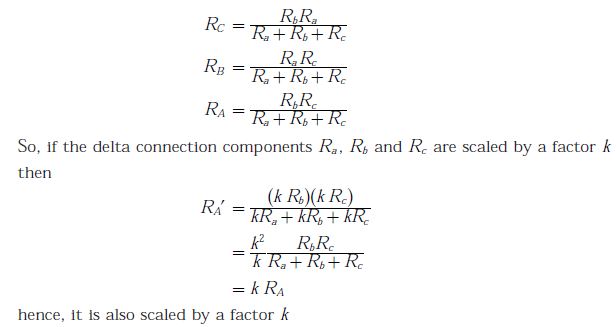
Consider a delta connection of resistors and its equivalent star connection as shown below. If all elements of the delta connection are scaled by a factor k, k > 0, the elements of the corresponding star equivalent will be scaled by a factor of
Answer : Option B
Explaination / Solution:
In the equivalent star connection, the resistance can be given as
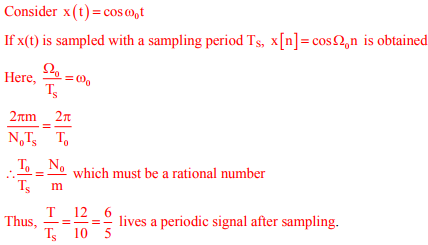
Q3. A continuous-time function x(t) is periodic with period T. The function is sampled uniformly
with a sampling period TS. In which one of the following cases is the sampled signal periodic?
Answer : Option B
Explaination / Solution:
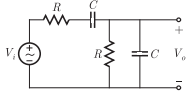
Q4. The circuit shown below is driven by a sinusoidal input Vi = Vpcos(t/RC). The
steady state output vo
Answer : Option A
Explaination / Solution:
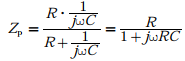
parallel combination of R and C equivalent impedance is
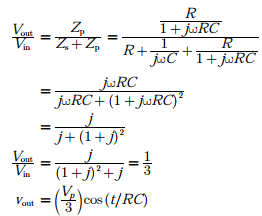
Transfer function can be written as
Q5. Match the inferences X, Y, and Z, about a system, to the corresponding properties of the elements of first column in Routh‟s Table of the system characteristic equation
X: The system is stable … P: … when all elements are positive
Y: The system is unstable … Q: … when any one element is zero
Z: The test breaks down … R: … when there is a change in sign of coefficients
Answer : Option D
Explaination / Solution:
No Explaination.
Q6. The transfer function 
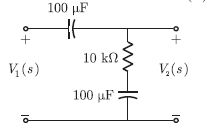
Answer : Option D
Explaination / Solution:
For the given capacitance,  in the circuit, we have the reactance.
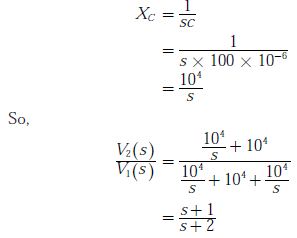
in the circuit, we have the reactance.
Q7. A first-order low-pass filter of time constant T is excited with different input signals (with zero
initial conditions up to t = 0). Match the excitation signals X, Y, Z with the corresponding time
responses for t ≥ 0:
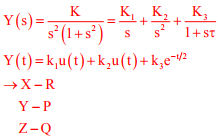
X: Impulse P: 1 – e-t/T
Y: Unit step Q: t – T(1 – e(-t/T)
Z :Ramp R: e-t/T
Answer : Option C
Explaination / Solution:
In general the first order, L.P.F filter transfer function is  because G(0) = k and G(∞) = ∞ if we take this transfer function as reference and give different input such as
s(t).r(t).u(t)
because G(0) = k and G(∞) = ∞ if we take this transfer function as reference and give different input such as
s(t).r(t).u(t)
because G(0) = k and G(∞) = ∞ if we take this transfer function as reference and give different input such as
s(t).r(t).u(t)
Q8. A source  has an internal impedance of
  If a purely resistive load connected to this source has to extract the maximum power out of the source, its value inΩ should be
has an internal impedance of If a purely resistive load connected to this source has to extract the maximum power out of the source, its value inΩ should be
Answer : Option C
Explaination / Solution:
For the purely resistive load, maximum average power is transferred when

where
 is the equivalent thevinin (input) impedance of the circuit. Hence,
we obtain
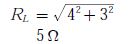
where
is the equivalent thevinin (input) impedance of the circuit. Hence,we obtain
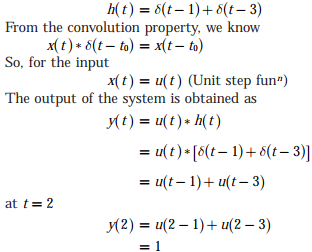
Q9. The impulse response of a continuous time system is given by  The value of the step response at t = 2 is
The value of the step response at t = 2 is
Answer : Option B
Explaination / Solution:
Q10. In the circuit shown below, the Norton equivalent current in amperes with
respect to the terminals P and Q is
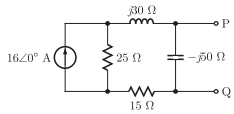
Answer : Option A
Explaination / Solution:
Replacing P - Q by short circuit as shown below we have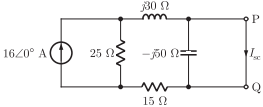

Using current divider rule the current ISC is