Communications - Online Test
Q1. 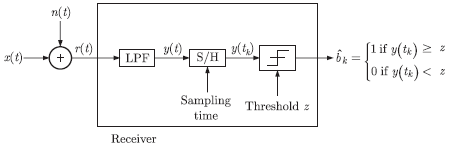
Consider a baseband binary PAM receiver shown below. The additive channel noise n(t) is with power spectral density  The lowpass filter is ideal with unity gain and cut-off frequency 1 MHz. Let Yk represent the random variable y(tk).
The lowpass filter is ideal with unity gain and cut-off frequency 1 MHz. Let Yk represent the random variable y(tk).Yk = Nk , if transmitted bit bk = 0
Yk = a + Nk if transmitted bit bk = 1
Where Nk represents the noise sample value. The noise sample has a probability density function,  (This has mean zero and variance 2/α2). Assume transmitted bits to be equiprobable and threshold z is set to a/2 = 10-6 V.
(This has mean zero and variance 2/α2). Assume transmitted bits to be equiprobable and threshold z is set to a/2 = 10-6 V.The probability of bit error is
Answer : Option D
Explaination / Solution:
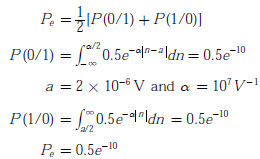
Probability of error is given by
Q2. need for modulation also arises from
Answer : Option C
Explaination / Solution:
No Explaination.
Q3. Pulse is specified by pulse height or the peak voltage, the pulse duration and pulse to pulse spacing. In pulse amplitude modulation (PAM) what changes with base band signal is
Answer : Option A
Explaination / Solution:
No Explaination.
Q4. In a digital communication system, the overall pulse shape p(t) at the receiver before the sampler has the Fourier transform P(f). If the symbols are transmitted at the rate of 2000 symbols per second, for which of the following cases is inter symbol interference zero?
Answer : Option B
Explaination / Solution:
For ISI free pulse,
If P(t) is having spectrum P(f)
Then  = constant
= constantRs = 2KSpa
Thin condition is met by pulse given in option B.
Q5. To reduce the distortion in amplitude modulation, modulation index is kept
Answer : Option A
Explaination / Solution:
No Explaination.
Q6. Which one of the following statements about differential pulse code modulation (DPCM) is true?
Answer : Option D
Explaination / Solution:
DPCM Block diagram
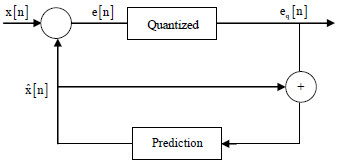
eq[n] is quantized e[n]
e[n] is difference of message signal sample with its prediction.
Q7. A message signal of frequency 10 kHz and peak voltage of 10 volts is used to modulate a carrier of frequency 1 MHz and peak Voltage of 20 volts. Determine the modulation index
Answer : Option A
Explaination / Solution:
No Explaination.
Q8. Consider a wireless communication link between a transmitter and a receiver located in free space, with finite and strictly positive capacity. If the effective areas of the transmitter and the receiver antennas, and the distance between them are all doubled, and everything else remains unchanged, the maximum capacity of the wireless link
Answer : Option C
Explaination / Solution:
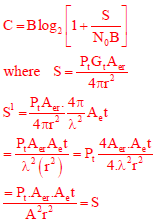
Channelcpacity remain same.
Q9. A message signal of frequency 10 kHz and peak voltage of 10 volts is used to modulate a carrier of frequency 1 MHz and peak voltage of 20 volts. Determine the side bands produced.
Answer : Option C
Explaination / Solution:
No Explaination.
Q10. In binary frequency shift keying (FSK), the given signal waveform are
u0 (t) = 5cos (20000 πt); 0 ≤ t ≤ T, and
u1 (t) = 5cos (22000 πt); 0 ≤ t ≤ T,
Where T is the bit-duration interval and t is in seconds. Both u0 (t) and u1 (t) are zero outside the interval 0 ≤ t ≤ T. With a matched filter (correlator) based receiver, the smallest positive value of T (in milliseconds) required to have u0 (t) and u1 (t) uncorrelated is
Answer : Option B
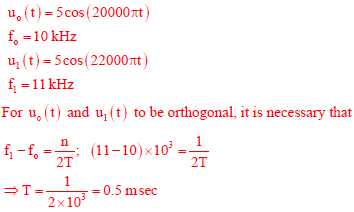
Explaination / Solution: