Logical Reasoning - Online Test
Count the number of parallelogram in the given figure.

The figure may be labelled as shown.
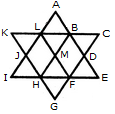
The simplest parallelograms are LMHJ and BDFM i.e. 2 in number. The parallelograms composed of two components each are ABML and MFGH i.e. 2 in number.
The parallelograms composed of three components each are LBHI, LBEF, BDGH, DFLA, BCFH, KLFH, A6HJ and LFGJ i.e. 8 in number.
The parallelograms composed of six components each are LCFI, KBEH and ADGJ i.e. 3 in number.
Total number of parallelograms in the figure = 2 + 2 + 8 + 3 = 15.
Count the number of convex pentagons in the adjoining figure.

A convex pentagon has no angles pointing inwards. More precisely, no internal angles can be more than 180°.
The figure may be labelled as shown.

The pentagons in the figure, are ABDFH, CDFHB, EFHBD, GHBDF, ACDFG, CEFHA, EGHBC, GABDE, BDEGH, DFGAB, FHACD and HBCEF. Clearly, these are 12 in number.
Count the number of rectangles in the given figure.

The figure may be labelled as shown.
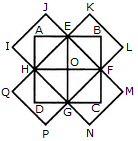
The rectangles composed of two components each are HIJE, EKJ,F, FMNG, GPQH, AEOH, EBFO, OFCG and HOGD i.e. 8 in number.
The rectangles composed of four components each are ABFH, BCGE, CDHF, DAEG and EFGH i.e. 5 in number.
The rectangles composed of six components each are IJFG, KLGH, MNHE and PQEF i.e. 4 in number.
The rectangles composed of eight components each are IJMN, KLPQ and ABCD i.e. 3 in number.
Thus, there are 8 + 5 + 4 + 3 = 20 rectangles in the given figure.
(Here note that the squares are also counted amongst rectangles)
Count the number of triangles and squares in the given figure.

The figure may be labelled as shown.
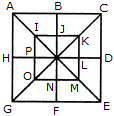
Triangles :
The simplest triangles are IJQ, JKQ, KLQ, LMQ, MNQ, NOQ, OPQ and PIQ i.e. 8 in number. The triangles composed of two components each are ABQ, BCQ, CDQ, DEQ, EFQ, FGQ, GHQ, HAQ, IKQ, KMQ, MOQ and OIQ i.e. 12 in number.
The triangles composed of four components each are ACQ, CEQ, EGQ, GAQ, IKM, KMO, MOI and OIK i.e. 8 in number.
The triangles composed of eight components each are ACE, CEG, EGA and GAC i.e. 4 in number.
Total number of triangles in the figure = 8 + 12 + 8 + 4 = 32.
Squares :
The squares composed of two components each are IJQP, JKLQ, QLMN and PQNO i.e. 4 in number.
The squares composed of four components each are ABQH, BCDQ, QDEF and HQFG i.e. 4 in number.
There is only one square i.e. IKMO composed of eight components.
There is only one square i.e. ACEG composed of sixteen components.
Thus, there are 4 + 4 + 1 + 1= 10 squares in the given figure.
Determine the number of rectangles and hexagons in the given figure.
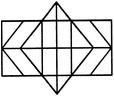
The figure may be labelled as shown.
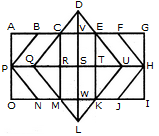
Rectangles:
The simplest rectangles are CVSR, VETS, RSWM and STKW i.e. 4 in number.
The rectangles composed of two components each are CETR, VEKW, RTKM and CVWM i.e. 4 in number.
The rectangles composed of three components each are ACRP, PRMO, EGHT and THIK i.e. 4 in number.
The rectangles composed of four components each are CEKM, AVSP,PSWO, VGHS and SHIW i.e. 5 in number.
The rectangles composed of five components each are AETP, PTKO, CGHR and RHIM i.e. 4 in number.
The rectangles composed of six components each are ACMO and EGIK i.e. 2 in number.
The rectangles composed of eight components each are AGHP, PHIO, AVWO and VGIW i.e. 4 in number.
The rectangles composed of ten components each are AEKO and CGIM i.e. 2 in number.
AGIO is the only rectangle having sixteen components.
Total number of rectangles in the given figure
= 4 + 4 + 4 + 5 + 4 + 2 + 4 + 2 + 1 = 30.
Hexagons:
The hexagons in the given figure are CDEKLM, CEUKMQ, CFHJMQ, BEUKNP and BFHJNP.
So, there are 5 hexagons in the given figure.